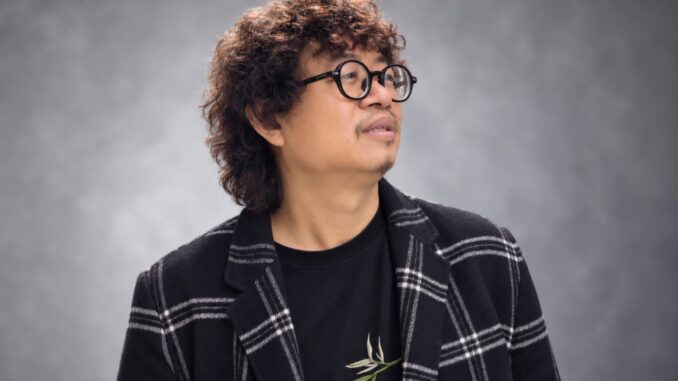
In Xi’an, a city that once stood at the heart of the ancient Silk Road, Chinese poet Cao Shui occupies a distinctive place in the contemporary movement of poetry across cultures. Poet, novelist, screenwriter, translator and literary organiser, Cao Shui has spent much of his career asking a large question: how can poetry speak across the boundaries of language, history and civilisation?
His answer has been both literary and practical. He writes poetry that moves across continents and civilisations, while also creating international platforms through which poets from different countries can meet.
Cao Shui is a member of the China Writers Association and China Poetry Society. He serves as an Asian Coordinator of the World Poetry Movement, and the World Poetry Movement currently lists him among its Asian continental coordinators. He is also closely associated with the Great Poetry Movement, which he helped launch in 2007. Its central idea is to bring together different cultural traditions rather than treating them as isolated worlds: ancient and modern, Eastern and Western, sacred and secular. The movement seeks to create new poetic imagery from the encounter between these traditions. This philosophy provides an important key to understanding Cao Shui’s literary work.
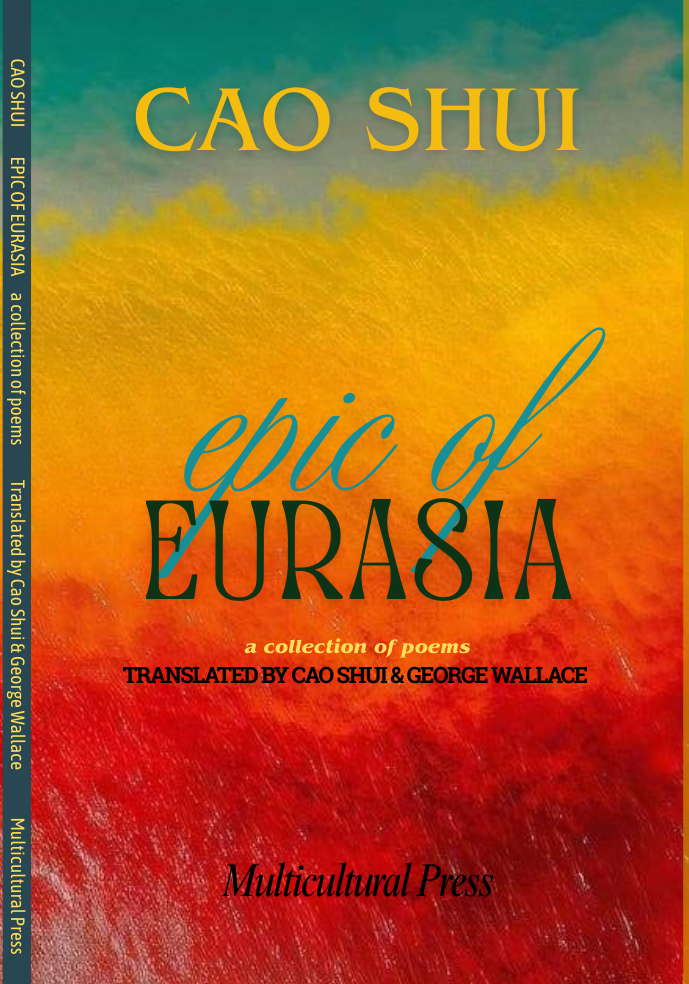
Eurasia, the ancient world, mythology, civilisation, migration and the relationship between human beings and the universe repeatedly appear in his writing. His work has been translated into numerous languages, including English, Italian, Spanish, French, German, Russian, Arabic, Japanese, Korean, Hindi and Vietnamese. Among his best-known works is Epic of Eurasia, a large-scale poetic project that brings together history, mythology, geography and imagination. The work has itself travelled across languages, with editions and translations appearing internationally. For Cao Shui, Eurasia becomes a poetic space in which different civilisations can encounter one another. Dragons, horses, deserts, mountains, ancient cities and celestial landscapes appear not merely as decorative images. They form part of a larger imaginative map. The poet moves between the historical and the mythical, the intimate and the monumental, asking how humanity understands itself within the enormous scale of time and space. This vision is particularly evident in the English edition of Epic of Eurasia being launched at the Xi’an forum.
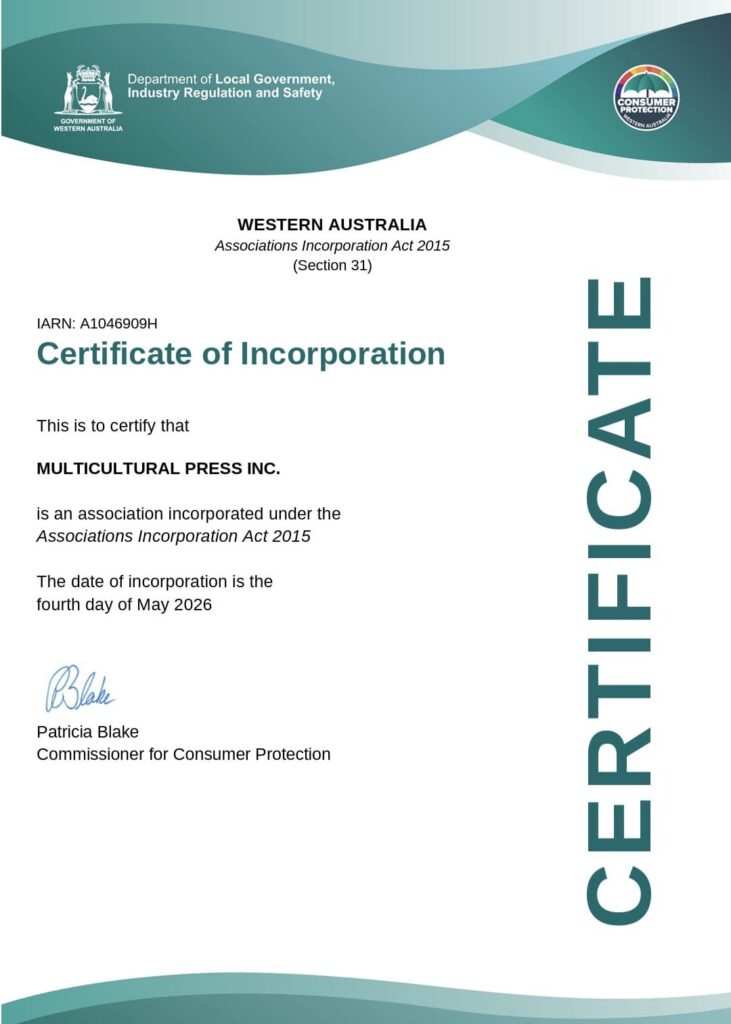
Published in 2026 by Multicultural Press Inc., Australia, the English edition is translated by American poet and translator George Wallace, with Vo Thi Nhu Mai as editor. For the publisher, the book represents more than the English-language publication of a Chinese poet. It is another stage in the journey of the work itself: a Chinese literary imagination entering a wider international readership. For Vo Thi Nhu Mai, the editor of the English edition, translation is itself a form of cultural bridge-building. Cao Shui’s poems move into English while carrying with them their historical references, philosophical questions and cultural imagery.
This makes the launch especially appropriate in Xi’an. The city was once Chang’an, one of the great centres of the Tang dynasty and one of the principal eastern gateways of the ancient Silk Road. Today, the city is once again becoming a meeting place for contemporary cultural exchange. Cao Shui’s work fits naturally into this landscape because his imagination is already concerned with movement between civilisations. His international literary activities have taken him to poetry festivals and cultural gatherings around the world, including the Medellín International Poetry Festival, the Havana International Poetry Festival and international poetry events in India and elsewhere.
His poetry has also been part of international literary publications. The World Poetry Movement’s Poetry Planetariat, for example, presents Cao Shui as a Chinese poet, novelist, screenwriter and translator and describes his Great Poetry Movement as an attempt to integrate sacred and secular cultures, Eastern and Western cultures, and ancient and modern cultures. This international orientation is not separate from his Chinese literary identity. Instead, it is part of it. Cao Shui’s work suggests that cultural identity does not have to become smaller when it enters the international sphere. A poem can remain deeply connected to its own language and history while still speaking to readers who live thousands of kilometres away. That is one of the central challenges of translation. A translator does not simply carry vocabulary from one language to another. The translator carries images, memories, historical associations and ways of thinking. In the English Epic of Eurasia, George Wallace and Cao Shui bring this vast poetic world to English-language readers, while Vo Thi Nhu Mai’s editorial work helps shape the English edition for its new cultural context. The result is another form of Silk Road. The ancient Silk Road moved physical goods across mountains and deserts. Contemporary literary exchange moves books, poems, ideas and imagination.
Cao Shui has also been involved in several literary movements beyond the Great Poetry Movement, including poetry film and dramatic-literary projects. His work repeatedly explores the meeting point between different artistic forms. But perhaps his most important contribution is the creation of spaces where writers can encounter one another. The World Poetry Movement identifies him as one of its continental coordinators in Asia, placing him within an international network connecting poets across numerous countries. In this sense, Cao Shui’s role extends beyond his own poems. He is simultaneously poet, organiser, editor, translator and cultural connector.
This is why his presence at the Xi’an: Capital of Tang Poetry, Silk Road Aesthetics Study Forum is significant. He is not only presenting a keynote lecture on Xi’an as the capital of Tang poetry and a potential world capital of poetry. He is also participating in the launch of his English-language Epic of Eurasia, presenting awards, interpreting Vo Thi Nhu Mai’s keynote speech, and joining the bilingual poetry recital. The different roles reveal the same underlying idea: poetry is not only something to be written. It is something to be carried. At the forum, Cao Shui carries poetry between Chinese and English. He carries contemporary literature into conversation with Tang poetry. He carries Chinese poetry into international literary networks. And through Epic of Eurasia, he carries an expansive vision of the Eurasian world towards English-language readers. There is an interesting circularity in this.
The ancient Silk Road began as a network of routes connecting peoples who did not necessarily share the same language. Yet exchange became possible through movement, translation, curiosity and encounter. Cao Shui’s literary work continues that principle in another form.The road is now made not only of deserts and mountains, but of books, translations, festivals, classrooms and digital communication. And the cargo is poetry.
In the Xi’an forum, Cao Shui stands at the centre of that contemporary exchange: a Chinese poet looking outward towards the world, while bringing the world back into dialogue with Chinese literary culture. His Epic of Eurasia is therefore more than a book about a vast geographical space. It is an attempt to imagine humanity as interconnected. And its English publication by Multicultural Press Australia adds another crossing to that long poetic road, from Chinese into English, from one literary culture into another, and from the ancient landscapes of Eurasia into the imagination of a new generation of readers. The Silk Road has changed but the journey of poetry continues.
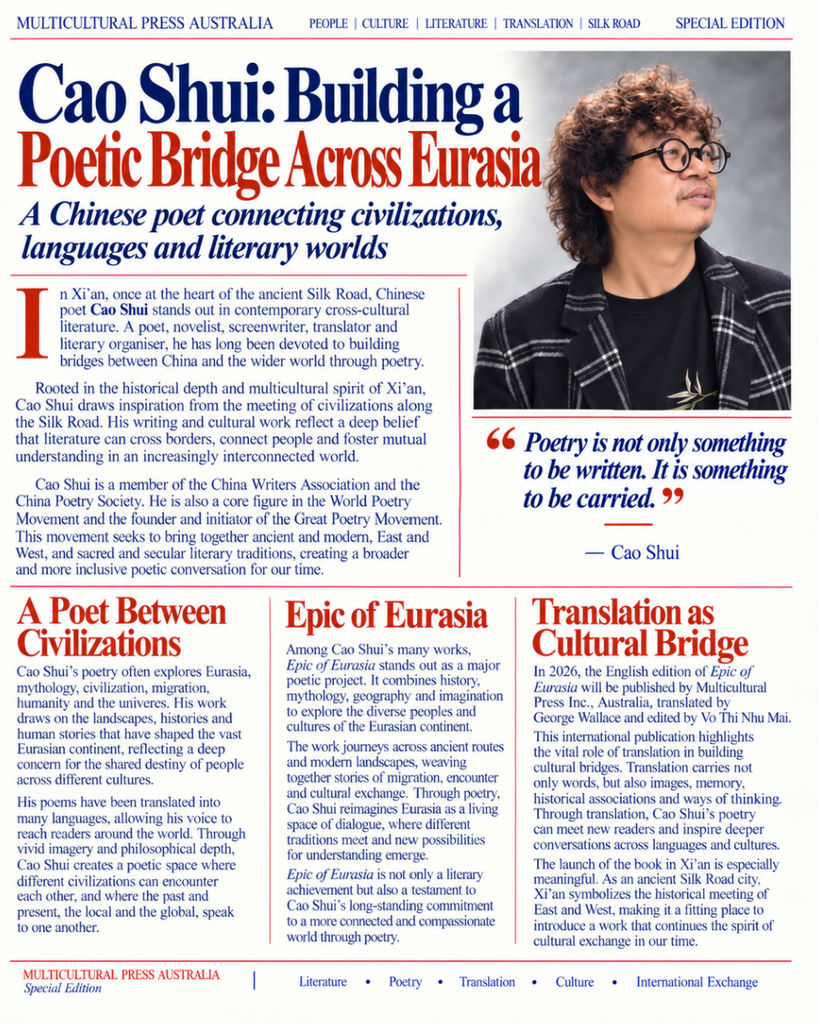
曹谁:以诗歌架起欧亚文明之桥
在西安这座曾经处于古代丝绸之路核心地带的城市里,中国诗人曹谁在当代跨文化诗歌运动中占据着一个独特的位置。作为诗人、小说家、编剧、翻译家和文学活动组织者,曹谁在自己的文学生涯中一直思考着一个宏大的问题:诗歌如何跨越语言、历史与文明的边界?他的回答既体现在文学创作中,也体现在实际行动中。他创作穿越不同大陆和文明的诗歌,同时也积极搭建国际交流平台,让来自不同国家的诗人有机会相遇、交流。
曹谁是中国作家协会会员、中国诗歌学会会员。他担任世界诗歌运动亚洲协调员,目前世界诗歌运动也将他列为亚洲大陆协调员之一。他还与“大诗主义”密切相关,并于2007年参与发起这一文学运动。“大诗主义”的核心理念,是把不同文化传统汇聚到一起,而不是把它们看作彼此隔绝的世界:古代与现代、东方与西方、神圣与世俗,都可以在诗歌中相遇。这个运动希望通过不同文化传统之间的碰撞与融合,创造新的诗歌意象。这一理念,也是理解曹谁文学创作的一把重要钥匙。
欧亚大陆、古代世界、神话、文明、迁徙,以及人与宇宙之间的关系,反复出现在曹谁的作品中。他的作品已经被翻译成多种语言,包括英语、意大利语、西班牙语、法语、德语、俄语、阿拉伯语、日语、韩语、印地语和越南语等。他最著名的作品之一是《欧亚史诗》。这是一项规模宏大的诗歌工程,将历史、神话、地理与想象融为一体。这部作品本身也不断跨越语言边界,以不同版本和译本在世界各地出版。对于曹谁来说,欧亚大陆不仅是一个地理概念,更是一个不同文明能够相互相遇的诗性空间。龙、马、沙漠、群山、古城和星空,并不仅仅是装饰性的意象,而是共同构成了一幅更为辽阔的想象地图。诗人在历史与神话之间、个人经验与宏大叙事之间不断穿行,追问人类如何在漫长的时间和广阔的空间中认识自己。此次在西安论坛发布的英文版《欧亚史诗》,尤其鲜明地体现了这样的文学视野。
《欧亚史诗》英文版于2026年由澳大利亚多元文化出版社(Multicultural Press Inc.)出版,由美国诗人、翻译家乔治·华莱士(George Wallace)翻译,武氏如梅(Vo Thi Nhu Mai)担任编辑。对于出版社来说,这本书的意义不仅仅是把一位中国诗人的作品介绍给英语世界,它也标志着这部作品自身旅程的又一个阶段:中国文学的想象力由此进入更广阔的国际读者群。对于英文版编辑武氏如梅来说,翻译本身就是一种搭建文化桥梁的方式。曹谁的诗进入英语之后,也把其中的历史记忆、哲学思考和文化意象一起带入了另一种语言。
因此,这本书选择在西安发布,显得格外恰当。西安古称长安,曾是唐代最重要的城市之一,也是古代丝绸之路东方的重要门户。今天,这座城市正在再次成为当代文化交流的汇聚之地。曹谁的作品与这样的城市背景自然契合,因为他的文学想象本身就一直围绕着不同文明之间的流动与相遇展开。他的国际文学活动也把他带到了世界各地的诗歌节和文化活动,包括麦德林国际诗歌节、哈瓦那国际诗歌节,以及印度和其他地区举办的国际诗歌活动。
曹谁的诗歌也出现在许多国际文学出版物中。例如,世界诗歌运动旗下的《诗歌星球》(Poetry Planetariat)将曹谁介绍为中国诗人、小说家、编剧和翻译家,并将他所倡导的“大诗主义”描述为一种尝试:把神圣文化与世俗文化、东方文化与西方文化、古代文化与现代文化融合起来。这种国际视野并不是与他的中国文学身份相分离的,恰恰相反,它正是这一身份的一部分。曹谁的作品表明,一种文化在进入国际语境之后,并不需要因此缩小或削弱自己。诗歌完全可以深深扎根于自己的语言和历史,同时又能够与生活在数千公里之外的读者产生共鸣。这也是翻译面临的核心挑战之一。翻译者并不是简单地把词语从一种语言搬到另一种语言,而是在传递意象、记忆、历史联想以及一种文化思考世界的方式。在英文版《欧亚史诗》中,乔治·华莱士通过翻译,与曹谁共同把这个庞大的诗歌世界带给英语读者,而武氏如梅的编辑工作,则帮助英文版适应新的文化语境。由此产生的,是另一种形式的“丝绸之路”。古代丝绸之路穿越山脉与沙漠,运输的是实际的商品;今天的文学交流所传递的,则是书籍、诗歌、思想与想象。
除了“大诗主义”之外,曹谁还参与了诗电影、戏剧文学等多种文学和艺术实践。他的创作不断探索不同艺术形式之间的交汇。但也许,他最重要的贡献之一,是创造让不同作家彼此相遇的空间。世界诗歌运动将他列为亚洲大陆协调员之一,使他成为一个连接众多国家诗人的国际网络中的重要成员。从这个意义上说,曹谁的角色已经超越了他个人的诗歌创作。他既是诗人,也是组织者、编辑、翻译者和文化连接者。
这也是为什么曹谁参加“西安:唐诗之都·丝路美学研究论坛”具有特殊意义。他不仅将在论坛上围绕西安作为“唐诗之都”以及成为未来“世界诗歌之都”的可能性发表主旨演讲,同时还将参加英文版《欧亚史诗》的新书发布,参与颁奖,现场翻译武氏如梅的主旨发言,并参加中英双语诗歌朗诵。这些不同的角色其实都指向同一个基本理念:诗歌不仅仅是被写出来的,它也需要被传递。在论坛上,曹谁把诗歌带往中文与英文之间;把当代文学带入与唐诗的对话之中;把中国诗歌带进国际文学网络;也通过《欧亚史诗》,把一个辽阔的欧亚世界带向英语读者。这里面有一种很有意味的循环。
古代丝绸之路最初就是由一条条道路组成的网络,它连接着那些并不一定使用相同语言的人群。然而,正是通过迁徙、翻译、好奇与相遇,交流才成为可能。曹谁的文学实践正在以另一种方式延续这一原则。今天的道路已经不再只是沙漠和群山,也包括书籍、翻译、文学节、课堂和数字传播。而在这条新的道路上,被运送的是诗歌。
在西安论坛上,曹谁正处于这种当代交流的中心:作为一名中国诗人,他向世界望去,同时又把世界带回中国文学文化的对话之中。因此,《欧亚史诗》不仅仅是一本书写辽阔地理空间的作品,它也是一次把人类想象为彼此相互连接的尝试。而澳大利亚多元文化出版社出版的英文版,又为这条漫长的诗歌道路增加了一次新的跨越:从中文进入英文,从一种文学文化进入另一种文学文化,也从欧亚大陆古老而辽阔的历史风景,进入新一代读者的想象之中。丝绸之路已经改变,但诗歌的旅程仍在继续。
Leave a Reply