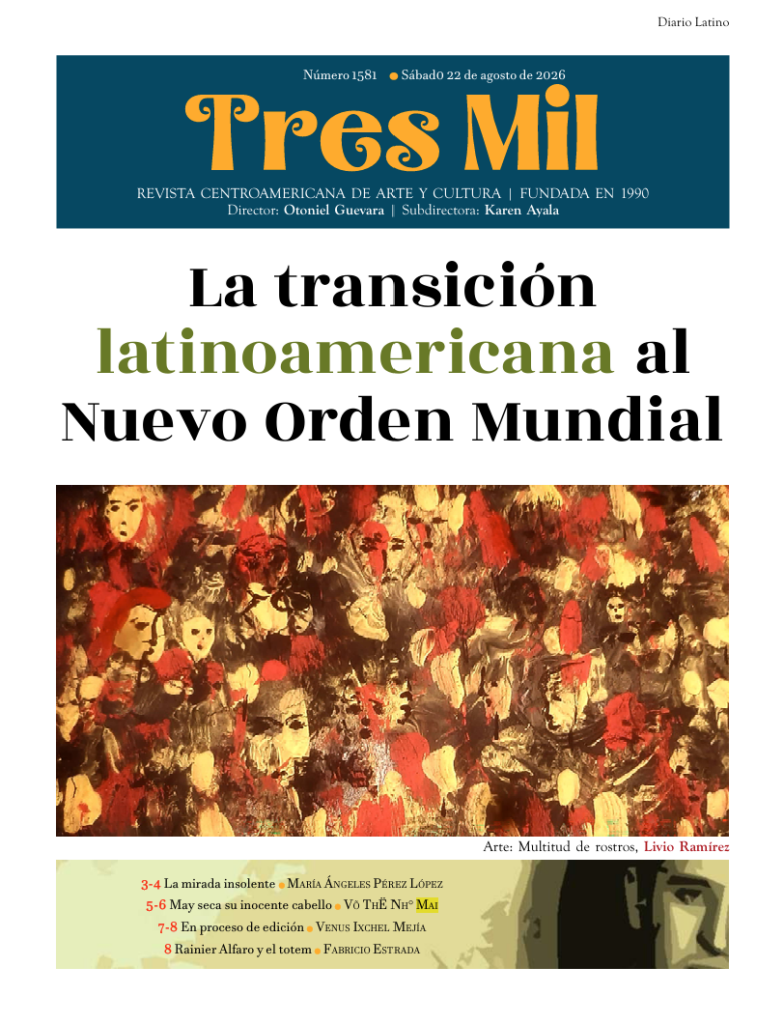
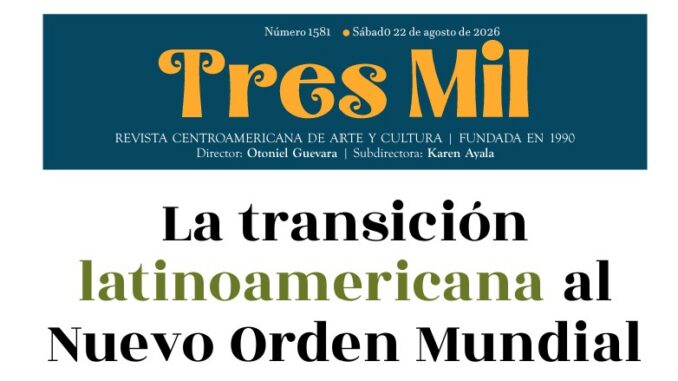
The 22 August 2026 issue of Diario Latino, published as Tres Mil, is a rich and ambitious literary and cultural magazine that brings together poetry, fiction, translation, visual art, political reflection, and literary criticism. Founded in 1990, the magazine is directed by Otoniel Guevara, with Karen Ayala as subdirector. This particular issue is especially compelling because it moves between the great political anxieties of the contemporary world and the intimate territories of the body, memory, love, language, and artistic creation.
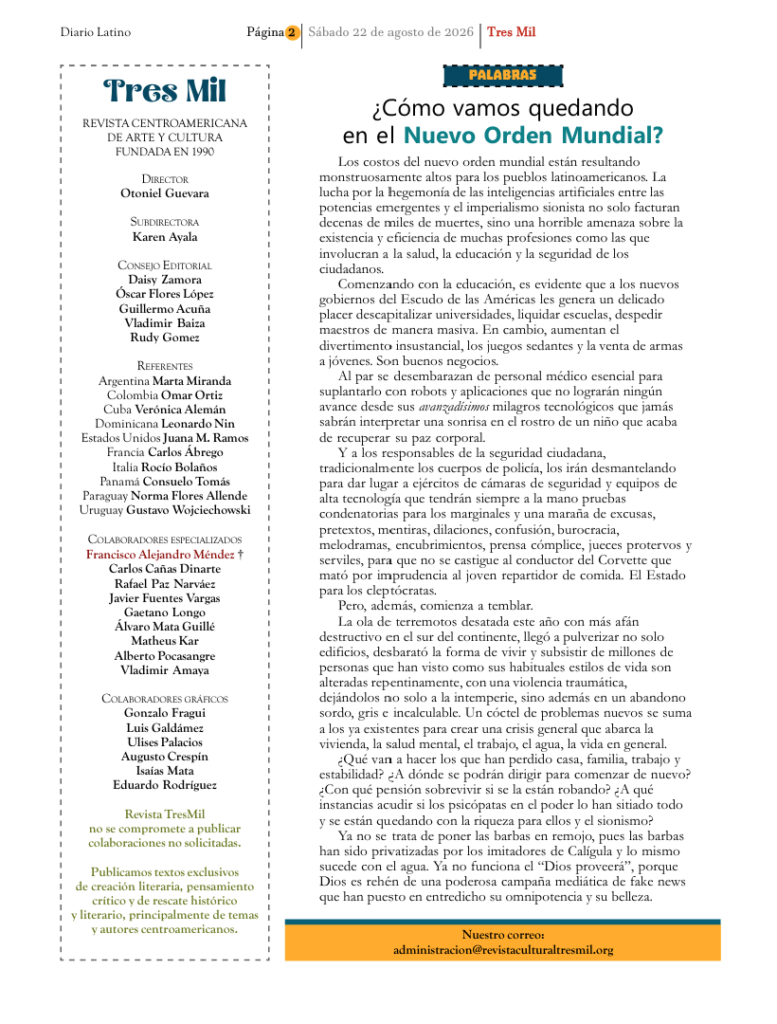
At the centre of the issue is a question suggested by its opening editorial, “¿Cómo vamos quedando en el Nuevo Orden Mundial?”: what happens to human beings when technological, political, and economic systems become more powerful than the people they are supposed to serve? The editorial, written in an intentionally provocative and confrontational style, examines education, healthcare, public security, technology, inequality, political power, and the devastating effects of earthquakes and social instability across Latin America. Its language is uncompromising, sometimes deliberately excessive, and deeply political.
Yet the most interesting aspect of the editorial becomes clearer when it is read beside the literary works that follow. The issue repeatedly returns to the value of the human: the ability to recognize suffering, to remember, to love, to create, to translate, to edit, and to give meaning to experiences that technology cannot simply quantify. The magazine’s political argument and its literary selections therefore belong to the same conversation.
María Ángeles Pérez López: the body as language
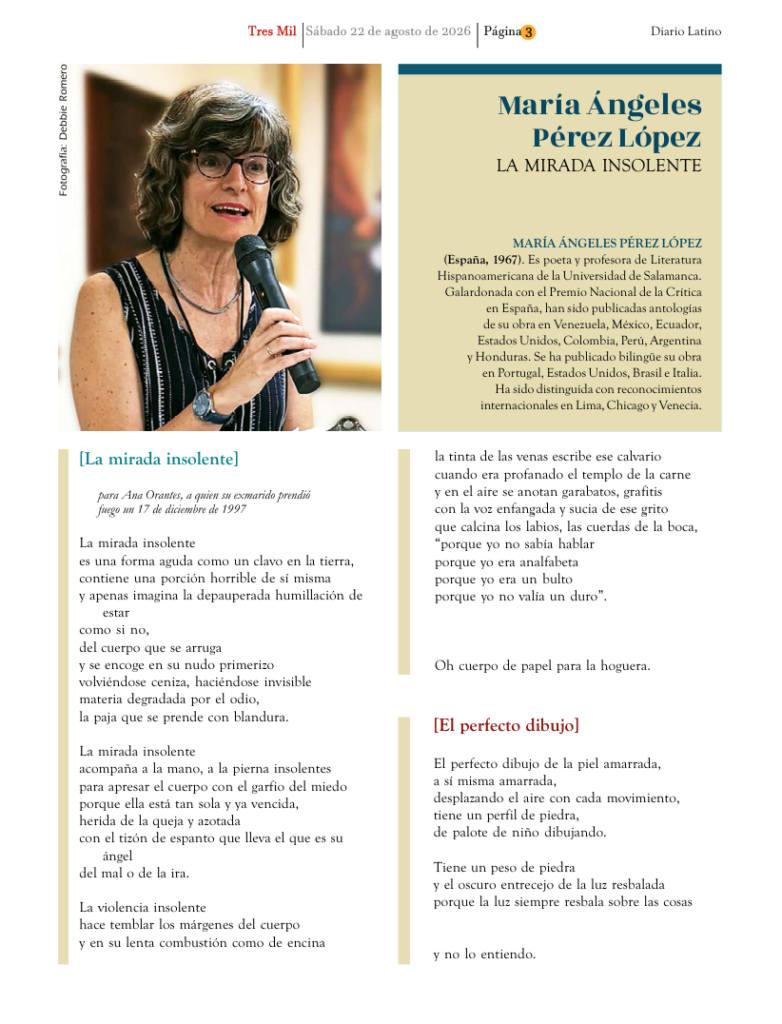
The poetry of María Ángeles Pérez López provides one of the most powerful sections of the issue. Her opening poem, “La mirada insolente,” is dedicated to Ana Orantes, the Spanish woman murdered by her former husband in 1997. Pérez López confronts gender violence through an intensely physical language in which the body becomes ash, paper, flesh, wound, fire, and memory.
The poem is difficult and deliberately so. Its images refuse to make violence comfortable. The “insolent gaze” becomes associated with the hand, the leg, fear, and the capture of the body. Violence is not presented as an abstract social concept but as something that happens to flesh.
Pérez López’s biography adds considerable weight to her presence in Tres Mil. Born in Spain in 1967, she is a poet and professor of Hispanic American Literature at the University of Salamanca. She has received Spain’s National Critics’ Prize, and her poetry has been published in anthologies across Venezuela, Mexico, Ecuador, the United States, Colombia, Peru, Argentina, and Honduras. Her work has also appeared bilingually in Portugal, the United States, Brazil, and Italy, with international recognition in Lima, Chicago, and Venice.
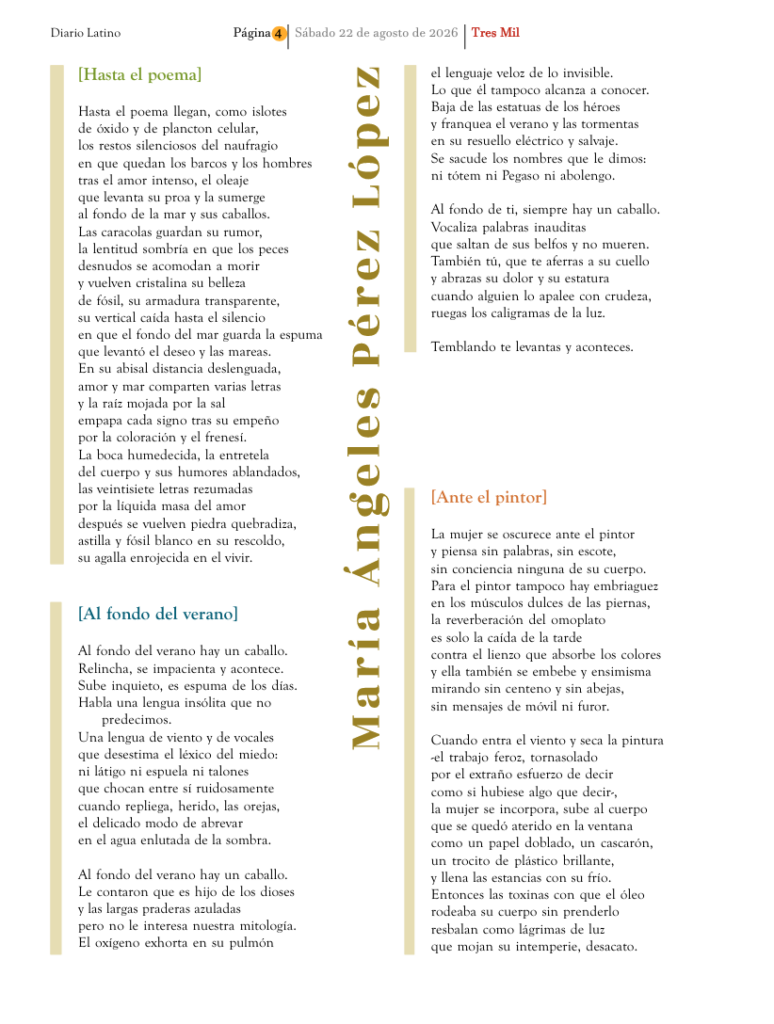
The issue includes several of her poems: “La mirada insolente,” “El perfecto dibujo,” “Hasta el poema,” “Al fondo del verano,” and “Ante el pintor.” Together they reveal a poet deeply interested in the relationship between body, image, landscape, desire, and artistic creation.
“Hasta el poema” is particularly beautiful. The remains of love are transformed into marine fragments: shells, fossils, salt, waves, submerged ships, and the residue of desire. Love becomes something archaeological, something that survives after the original experience has disappeared.
“Al fondo del verano” introduces one of the issue’s most memorable images: a horse. The animal speaks in “a language of wind and vowels,” beyond the mythology humans have constructed around it. The horse refuses the names imposed upon it—neither totem nor Pegasus nor inherited symbol. The poem therefore becomes an exploration of language itself: how we name the world, and how the world remains larger than our names for it.
The Spanish is sensuous and muscular. Words such as oleaje, resuello, frenesí, intemperie, desacato, and añoranza possess a physical texture that contributes to the poetry’s atmosphere. Pérez López demonstrates that poetic language does not merely describe experience; it creates a second body for it.
Vo Thi Nhu Mai: translation as cultural encounter
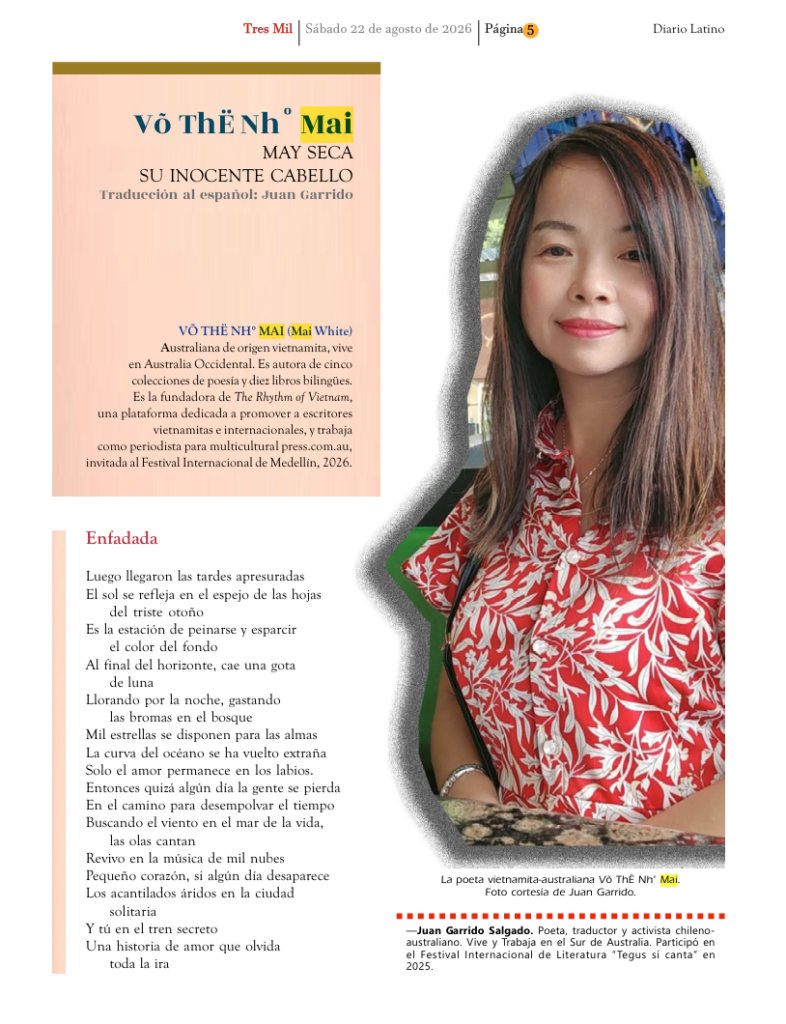
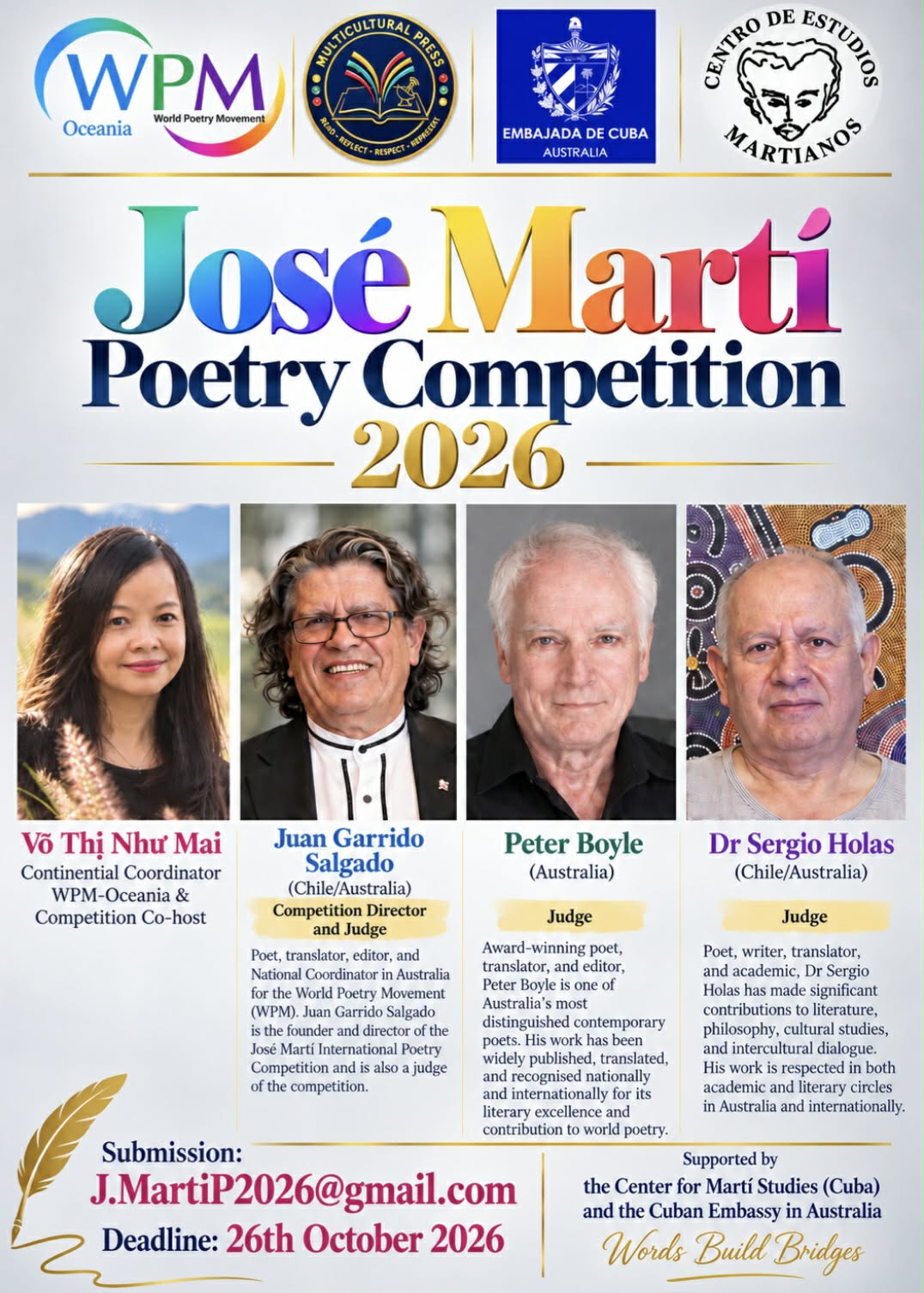
One of the most important contributions to this issue is the presentation of the poetry of Vo Thi Nhu Mai, an Australian poet of Vietnamese origin who lives in Western Australia.
Her poems appear in Spanish under the heading “May seca su inocente cabello,” translated by Juan Garrido Salgado. The translation is not a secondary feature of the publication; it is central to what makes this issue culturally significant.
Vo Thi Nhu Mai’s poems are filled with natural imagery—moonlight, oceans, hills, rain, forests, clouds, swallows, flowers, silk, wind, and changing seasons. But these images are never merely decorative. They become vehicles for longing, separation, memory, desire, youth, devotion, and the persistence of love.
The poem “¿Podrían el amor y la añoranza bastar de verdad?” is especially evocative. Its title itself establishes a question that remains suspended throughout the poem: can love and longing really be enough? The poem moves through waiting, separation, rain, moonlight, silk, flowers, and memory, gradually transforming private grief into something almost elemental.
The translation by Juan Garrido Salgado deserves particular attention. Literary translation is not simply the replacement of Vietnamese words with Spanish equivalents. It involves recreating rhythm, imagery, emotional tone, repetition, and musicality. A translated poem must feel alive in its new language while retaining something of the atmosphere of its original.
That is particularly challenging with poetry. Images that feel natural in one linguistic and cultural tradition can sound artificial in another. The translator must therefore make continuous decisions about sound, rhythm, metaphor, syntax, and emotional register.
Garrido’s work allows Vo Thi Nhu Mai’s poetry to enter the Spanish-speaking literary world without erasing its sense of distance and cultural difference. The result is not merely translation but literary dialogue.
This is especially meaningful given Vo Thi Nhu Mai’s own literary identity. She is Australian of Vietnamese origin, lives in Western Australia, is the author of five poetry collections and ten bilingual books, and is the founder of The Rhythm of Vietnam, a platform devoted to promoting Vietnamese and international writers. She also works as a journalist for multiculturalpress.com.au and was invited to the 2026 International Poetry Festival of Medellín.
Her presence in Tres Mil consequently expands the magazine’s geographical and linguistic horizon. A Central American literary publication becomes a meeting place for Vietnamese heritage, Australian multiculturalism, Spanish-language poetry, and Chilean-Australian translation.
This is one of the issue’s greatest strengths: it makes the international movement of literature visible.
“¿Podrían el amor y la añoranza bastar de verdad?”
The poem deserves special attention because of the tenderness of its imagery. Love appears through natural transformations: sunlight wraps itself around the shoulders; longing travels over hills; waves carry memories; swallows cross fields; dew nourishes sorrow; flowers open as if responding to compassion.
There is a delicate musicality in the repetitions of quizás, esperamos, te amé, and marchándose. The poem feels almost sung rather than simply written.
The translation’s achievement is therefore not only semantic. It is musical. It allows the Spanish reader to experience the poem as a sequence of emotional movements rather than as a literal transfer of information.
The final movement toward transformation is particularly effective. Love is not simply forgotten. It is gradually converted into memory, and memory becomes part of a future season. The poem ultimately suggests that longing may not disappear; instead, it changes form.
Venus Ixchel Mejía: the painful labour of editing
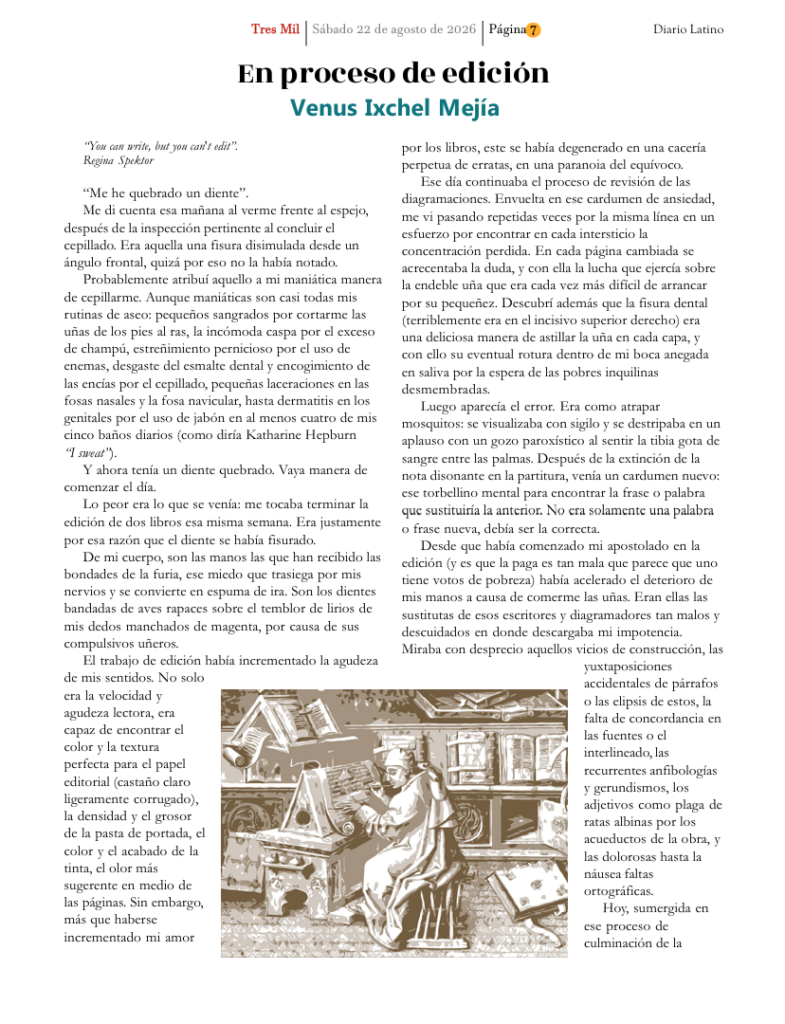
“En proceso de edición,” by Venus Ixchel Mejía, takes the reader into an entirely different literary world. It is funny, grotesque, anxious, obsessive, and increasingly disturbing.
The central character discovers that she has cracked a tooth. She is simultaneously in the middle of editing two books, and the pressure of editing has become inseparable from the condition of her body. Her hands, nails, teeth, nerves, and mouth become part of the editorial process.
Mejía’s great achievement is turning something apparently mundane—the correction of a manuscript—into a psychological and physical thriller.
The editor’s obsession with errors becomes almost pathological. Typographical mistakes, bad paragraph construction, inconsistent formatting, awkward syntax, unnecessary adjectives, gerundism, and spelling errors are treated as enemies. Editing becomes a form of hunting.
The prose is especially effective because its excess mirrors the protagonist’s anxiety. Sentences accumulate, images multiply, and the narrative itself begins to feel crowded and breathless. The missing paragraphs become the ultimate nightmare: something has disappeared from the book, and the editor cannot determine where it went.
The result is a sharp satire of literary publishing but also something more profound. The story asks what happens when the pursuit of perfection becomes destructive.
Mejía is a poet, editor, and teacher from Tegucigalpa, Honduras, born in 1979. She co-founded the Ixchel publishing houses in 2012 and Solsticio Ediciones in 2024, and won first place in the 2017 “Julio César Anariba” short narrative competition.
Her contribution also creates an unexpected connection with the translation of Vo Thi Nhu Mai’s poems. Both pieces expose forms of literary labour that readers rarely see. Translation makes a poem possible across languages; editing makes a text possible within its own language. Both require extraordinary attention.
Fabricio Estrada and Rainier Alfaro
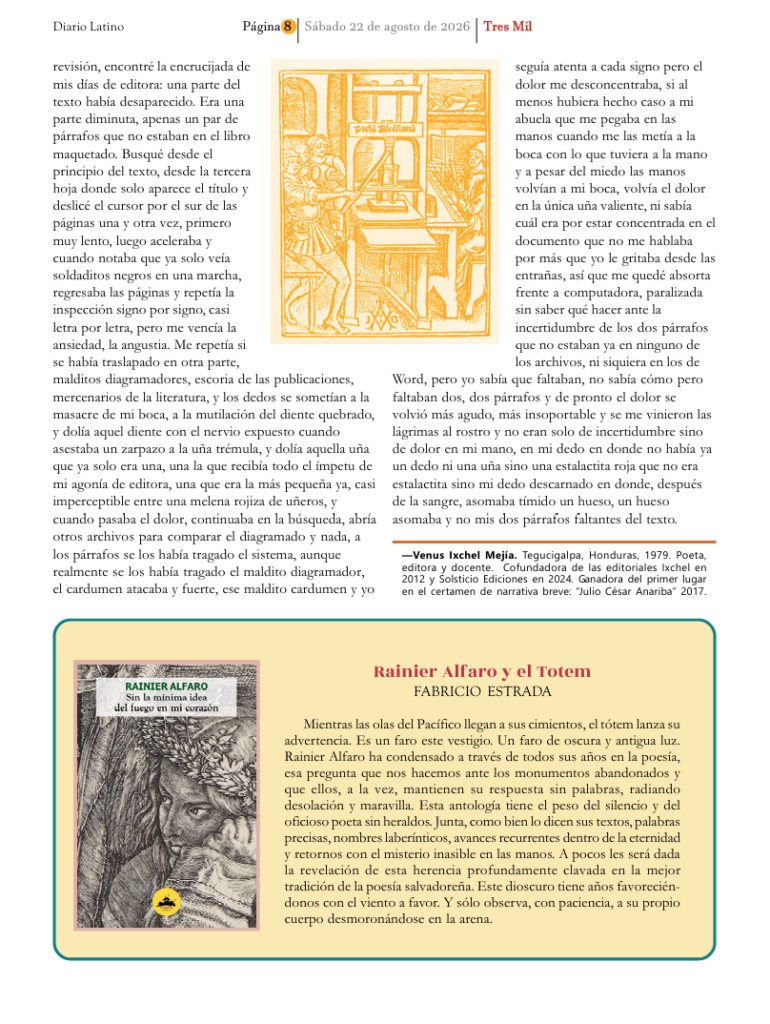
The final literary contribution, “Rainier Alfaro y el Totem,” by Fabricio Estrada, turns toward Salvadoran poetic heritage.
Estrada uses the image of a totem standing against the Pacific. The image is immediately striking: a monument surrounded by waves, carrying an ancient warning and radiating a mysterious light.
Rainier Alfaro is presented as a poet of silence, precision, mystery, and inheritance. Estrada suggests that Alfaro’s poetry asks the same questions that abandoned monuments ask: what remains after the people who built them are gone, and what can survive without explanation?
The prose is compact but highly poetic. The “totem” becomes both object and metaphor for the poet himself—a figure standing against time while the world changes around him.
Estrada’s tribute therefore extends one of the magazine’s most important themes: literary memory. Poetry is not only a contemporary act. It is also a way of preserving voices that might otherwise disappear.
The wider cultural constellation
The issue is strengthened by its broad network of contributors and cultural references.
The magazine’s editorial leadership consists of Otoniel Guevara, director, and Karen Ayala, subdirector. The editorial council includes Daisy Zamora, Óscar Flores López, Guillermo Acuña, Vladimir Baiza, and Rudy Gomez.
Its international references include Marta Miranda from Argentina, Omar Ortiz from Colombia, Verónica Alemán from Cuba, Leonardo Nin from the Dominican Republic, Juana M. Ramos from the United States, Carlos Ábrego from France, Rocío Bolaños from Italy, Consuelo Tomás from Panama, Norma Flores Allende from Paraguay, and Gustavo Wojciechowski from Uruguay.
The specialized contributors listed are Francisco Alejandro Méndez, Carlos Cañas Dinarte, Rafael Paz Narváez, Javier Fuentes Vargas, Gaetano Longo, Álvaro Mata Guillé, Matheus Kar, Alberto Pocasangre, and Vladimir Amaya.
The graphic contributors include Gonzalo Fragui, Luis Galdámez, Ulises Palacios, Augusto Crespín, Isaías Mata, and Eduardo Rodríguez. The issue also credits Debbie Romero for photography and presents the artistic work “Multitud de rostros,” by Livio Ramírez.
These names matter because they demonstrate the collective character of the publication. Tres Mil is not simply a container for individual texts. It is a cultural network linking writers, translators, editors, artists, photographers, critics, and readers across borders.
A magazine about language under pressure
Perhaps the most compelling way to understand this issue is as a magazine about language under pressure.
In the opening editorial, language becomes political confrontation.
In María Ángeles Pérez López’s poetry, language becomes flesh, fire, ocean, horse, light, and memory.
In Vo Thi Nhu Mai’s poetry, language crosses cultures through translation.
In Juan Garrido Salgado’s work, language becomes a bridge between Vietnamese poetic experience and Spanish readership.
In Venus Ixchel Mejía’s story, language becomes something obsessively corrected, hunted, lost, and recovered.
In Fabricio Estrada’s meditation on Rainier Alfaro, language becomes literary memory.
This makes the issue more coherent than it might initially appear. Its subjects are diverse, but its underlying concern is remarkably consistent: how can language preserve human experience in a world that is increasingly unstable, technologically mediated, politically polarized, and vulnerable to forgetting?
That question gives the issue its emotional unity.
Final assessment
No. 1581 of Diario Latino / Tres Mil is an intellectually restless and artistically varied issue. Its political editorial is provocative; its poetry is sensuous and often haunting; its fiction is darkly comic and physically intense; its tribute to Rainier Alfaro is atmospheric; and, especially importantly, its inclusion of Vo Thi Nhu Mai’s poetry in Spanish demonstrates the magazine’s openness to international literary exchange.
The translation by Juan Garrido Salgado is one of the issue’s most valuable achievements. It reminds us that literary cultures do not exist in isolation. Poems travel because translators carry them across borders, and in doing so they create new possibilities of recognition. Vo Thi Nhu Mai’s Vietnamese-Australian poetic world enters the Spanish-language sphere not as an exotic curiosity but as living literature.
There is beauty throughout the issue, but it is not a superficial beauty. It is the beauty of language struggling against disappearance: the body refusing to be forgotten, the lover refusing to let memory die, the editor refusing to let two paragraphs disappear, the translator refusing to let a poem remain inaccessible, and the poet standing like a totem against the erosion of time.
That is ultimately what makes this issue of Tres Mil worthwhile. It understands literature as both resistance and encounter. It gives space to Central American voices while opening its pages to Spain, Vietnam, Australia, Chile, and the wider international literary community. Most importantly, it demonstrates that language—when translated, edited, remembered, and lovingly shaped—can continue to cross borders even when the world itself seems increasingly determined to build them.