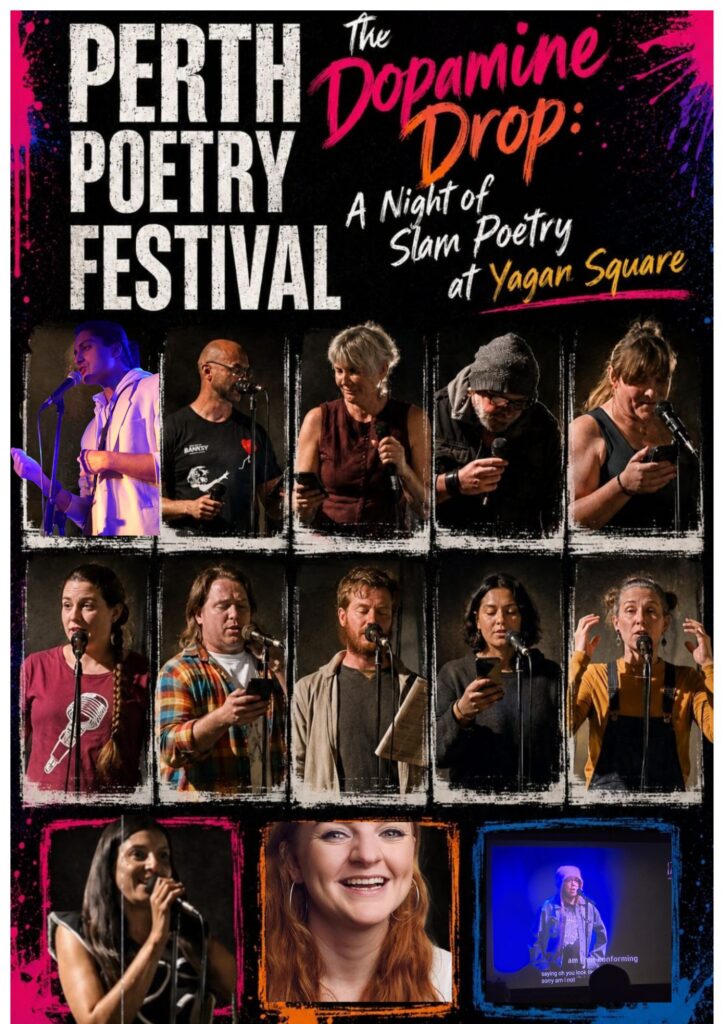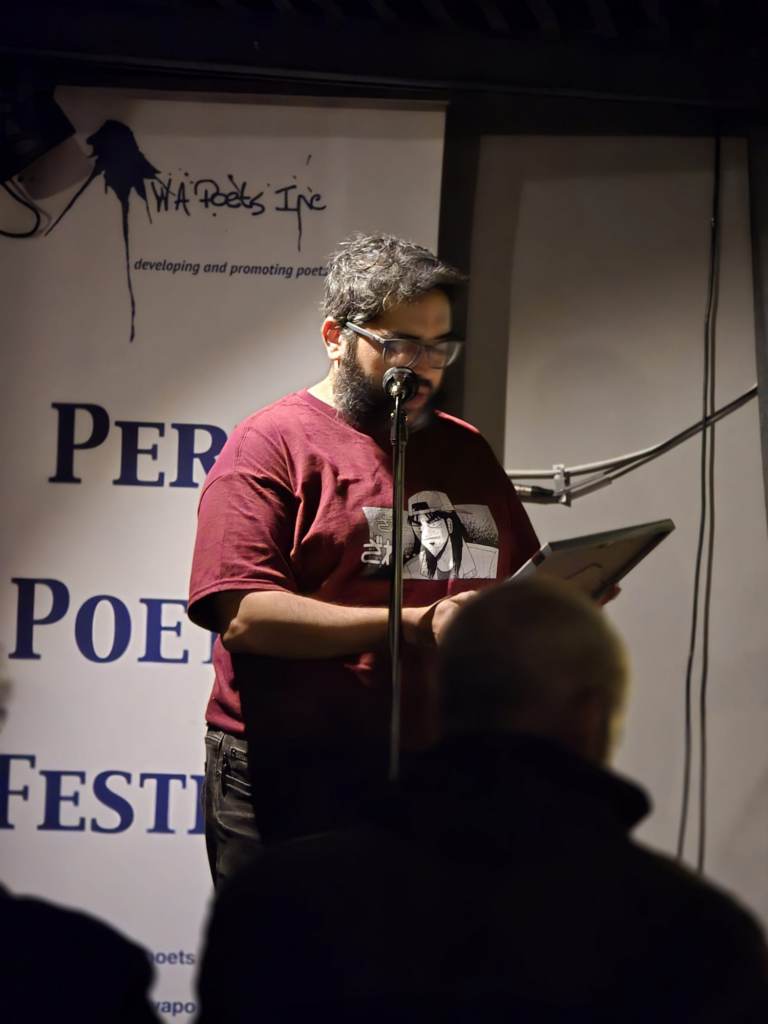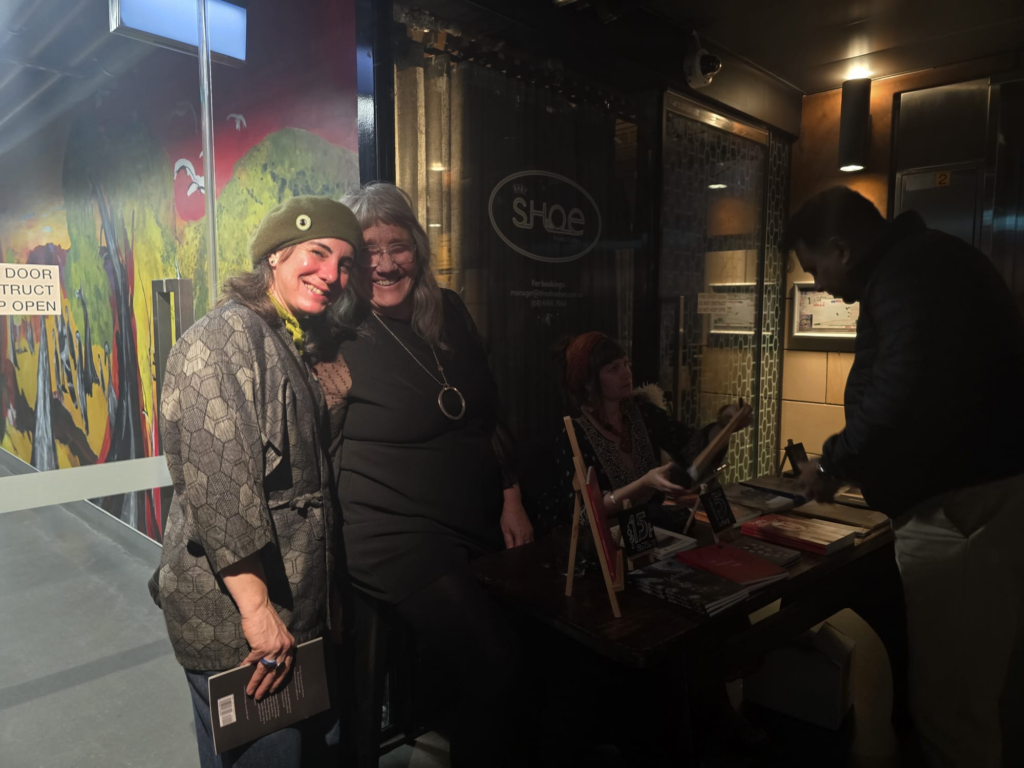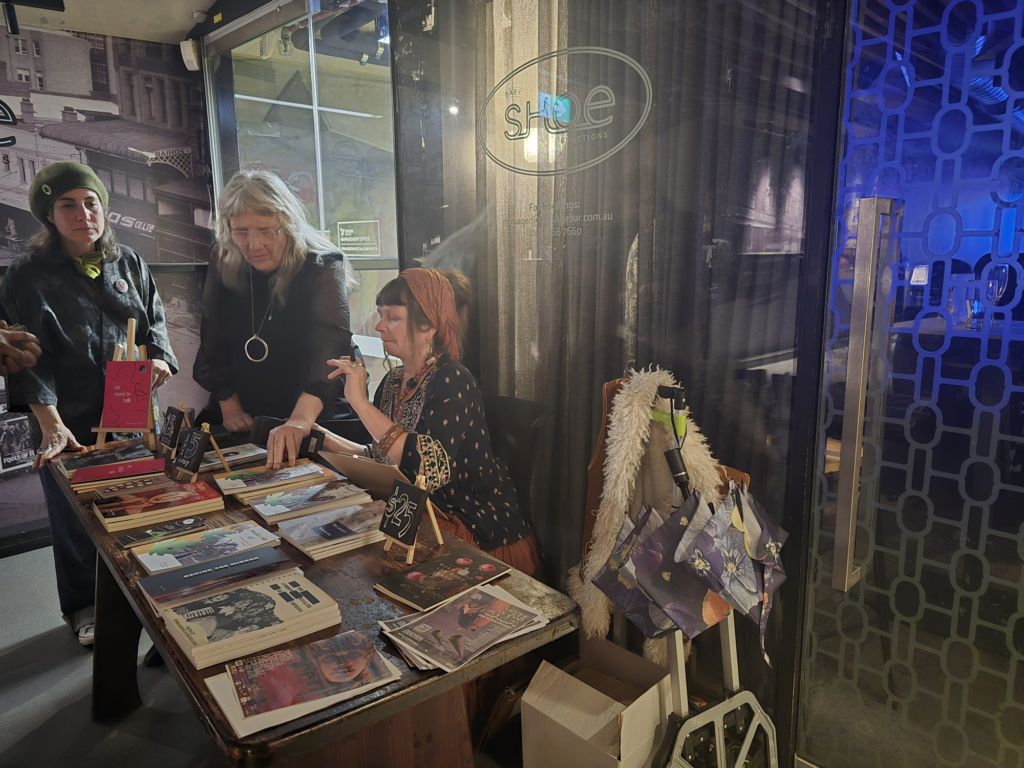

On Saturday 22 August, the Perth Poetry Festival 2026 brought an energetic night of slam poetry to Baby Shoe at The Shoe Bar and Café, Yagan Square, with The Dopamine Drop, a 7:00–8:30 pm showcase presented by WA Poets Inc. The program brought together a dynamic group of 12 poets and performers, creating an atmosphere for poetry to be read, performed by artists, felt and shared directly with the audience. The official festival program describes the event as a poetry showcase featuring performers, music and the charged atmosphere of a live poetry night.
The evening was hosted by Manveen Kohli, a British Indian spoken word poet, psychologist and two time Western Australian finalist in the Australian Poetry Slam, based in Perth. Alongside her work as a high school psychologist, Manveen is an active presence in the local and interstate poetry scene, regularly performing at events including the Perth Poetry Festival, Neon Readings and Spoken Word Perth. She is the author of the debut poetry collection We Need to Talk, co published in 2023 by Centre for Stories and Red River Press. A committee member of WA Poets Inc. and the coordinator of Woman Scream Perth, Manveen also frequently hosts, MCs and facilitates poetry workshops that create space for community voices. Her role as host brought warmth, confidence and continuity to The Dopamine Drop, guiding the audience through an evening that moved effortlessly between humour, vulnerability, social commentary and deeply personal stories.
Among the featured voices was Niel Smith, introduced as a former regular of the slam scene who had represented his city at the national finals at the Sydney Opera House in consecutive years. His poetry draws on observations of society, family and education, informed by his experiences as a father of five, a school principal and a first-generation Australian. Niel Smith delivered a powerful and confronting poem that used the image of swans and Australian rules football to examine male violence, victim blaming and the double standards surrounding women’s safety. Beginning with the familiar idea that swans mate for life, Smith sharply contrasts this romantic symbol of loyalty with the reality of women who experience violence from strangers and intimate partners. His references to football, including the “high tackle” and the language of the game, become a metaphor for the risks men face when challenging other men’s behaviour. The poem also questions the tendency to frame violence through immigration and cultural difference, pointing instead to the uncomfortable reality that violence can exist within mainstream Australian society. With courage and self scrutiny, Smith positions himself as a “black swan” willing to speak out, ending with a call for men to accept responsibility and learn what it truly means to “wear the consequences” rather than simply the jumper. It was a compelling performance that transformed a familiar Australian image into a pointed reflection on masculinity, accountability and the safety of women.
Karen Louise followed with a witty, intelligent and sharply feminist performance that moved between humour, domestic imagery and social critique. Her poem begins with the comforting nostalgia of Laura Ashley, imagining patterned dresses, beautiful fabrics, tea and an idealised domestic world, before gradually exposing the contradictions beneath that picture of “paradise.” With playful references to fashion, pockets, suffragettes, wealth and the privileges of modern life, Karen connects the everyday choices of women with the struggles of generations who fought for greater freedom and equality. Yet the poem does not remain in anger or critique. It turns toward a quieter question: what does it mean to leave the world “a little better than I found it”? In its closing images of moonlight, family and an open bedroom window, the poet chooses connection and peace over ownership and consumption. The performance balanced sharp social observation with warmth and humour, leaving the audience with the memorable idea that perhaps we do not need to own paradise to appreciate a moment of it.
Suraj Raja brought a deeply emotional and dramatic piece exploring pain, trauma, love and the difficult act of letting go. The poem takes the form of a conversation with a troubled “brother,” whose anguish has become so overwhelming that his attempt to protect the speaker turns into suffocation. The repeated images of gripping hands, bleeding fingers and a body held too tightly create a powerful metaphor for relationships in which love and pain become dangerously intertwined. Yet beneath the darkness, the poem carries a message of compassion: the speaker recognises the brother’s suffering but also understands that healing requires separation and freedom. The turning point comes when the speaker gently confronts him, saying that he has taken not only the body but the whole person. The final release is both heartbreaking and hopeful: “I must leave. I must grow. And I need you to let go.” Suraj’s performance gave the poem an intimate, almost theatrical quality, turning personal anguish into a universal reflection on boundaries, healing and the courage to release someone we love.
Allan Boyd, also known as the Antipoet, is a Perth-based performance poet and arts organiser known for his experimental approach to poetry and spoken-word performance. He has been delivering performance poetry and organising poetry, arts and music events in Perth since 1995. In the mid-1990s, he founded the Openmouth poetry sessions at PICA Bar, creating a space that brought together emerging poets, spoken-word performers, experimental artists and independent musicians. In The Dopamine Drop, he seemed to deliberately push language beyond conventional meaning, moving through rhyme, fractured phrases, playful sounds and images of wetlands, catchments, government and the environment. The poem’s title became especially fitting as the performance constantly shifted and surprised, creating little bursts of linguistic “dopamine.” Beneath the humour and verbal experimentation was a sharper awareness of place, politics and the natural world, reminding us that performance poetry can be both playful and provocative.
Joni Boyd brought a lively, humorous and sharply observant voice to the stage, drawing on her work as a promoter, community organiser, broadcaster and performer across Perth’s poetry and arts scene. Her poem explored the complicated question of identity and belonging, using repetition and a series of contrasting social labels to show how easily we can become different versions of ourselves depending on who we are with. The performance moved rapidly from one group to another, creating both laughter and recognition as the poet questioned where she truly fits. Beneath the playful language was a deeper reflection on the pressure to belong and the absurdity of being placed into neat categories. The poem finally found its home in poetry itself: among the slam community, she did not have to pretend to be anything else. “When I’m at slam, you know I’m a poet.” It was a confident and entertaining performance about finding identity in a world that constantly tries to define us.
Abigail was introduced as a poet originally from North Wales, who trained as an actor at the Royal Central School of Speech and Drama in London. Her background in performance brings a strong theatrical dimension to her poetry, connecting spoken word with the discipline and presence of the stage. She represented Western Australia as a finalist in the Australian Poetry Slam, reaching the national stage at the Sydney Opera House, and has also been part of the 2026 Woman Scream artist lineup. Her appearance at The Dopamine Drop added another distinctive voice to an evening that celebrated poetry not only as written language but as live performance, movement and personal expression.
Kym Dee brought a wonderfully playful and irreverent performance to the stage, drawing laughter from an imaginative poem about shoes, identity and survival. A Southwest writer and slam poet, Kym has performed from Bunbury to the Sydney Opera House, using vivid metaphors and sharp humour to transform ordinary observations into something unexpected. In this poem, shoes become much more than footwear: they suggest social status, fashion, practicality and even sexuality. Kym humorously celebrates “sensible shoes,” imagining them as essential equipment for everything from escaping giant lizards to surviving a zombie apocalypse. The poem also plays with the idea that footwear can send signals about sexual identity, turning stereotypes into a source of comedy and self expression. Her clever wordplay, absurd scenarios and confident delivery made the performance highly entertaining, while underneath the humour was a warm celebration of being comfortable with who we are rather than dressing to satisfy other people’s expectations.
Biddle delivered one of the evening’s most confronting and emotionally intense performances. Introduced as a poet whose work often moves through absurdism, biography and queer experience, Biddle brought a deeply personal piece about masculinity, family and violence. The poem begins with a disturbing memory of a brother becoming physically aggressive while drunk, and the speaker’s instinctive response is strikingly complicated by tenderness, fear and the familiar roles within a family. Images of drinking, pub culture, repeated movement and the inability to escape create a sense of trauma that keeps circling back on itself. The poem asks a painful question: why can simply existing as oneself not be enough? Its final image, in which the speaker remembers the brother becoming limp and reflects on feeling “more like my family” than ever before, is haunting and deeply ambiguous. Biddle’s performance demonstrated the power of slam poetry to take intimate and uncomfortable experiences and place them directly before an audience, without offering an easy resolution.
Jack Logan brought a quieter, atmospheric intensity to the evening, exploring the politics of memory, the morality of experience and the ways people and places change over time. His poem centred on a river and the disturbing traces of bodies and objects that surface from its depths. The imagery is stark and unsettling: dredging, mud, water, abandoned belongings and the remains of people whose stories may never be fully recovered. Rather than presenting a dramatic rescue or a neat conclusion, Logan focuses on the fragments that remain after tragedy — coins, clothing, identification cards and other ordinary objects washed ashore, carrying traces of lives that have disappeared. The poem gradually expands from one forgotten death into a meditation on history and repetition, asking how many similar stories have been lost or left unresolved. His restrained delivery and haunting imagery created a striking contrast to the more humorous and energetic performances earlier in the evening, reminding the audience that poetry can also give voice to the forgotten and make us look more closely at what a place remembers.
Nisha D’Cruz delivered one of the evening’s most poignant reflections on migration, memory, identity and belonging. A part-time writer and full-time curator, Nisha has written and performed with a range of literary and cultural programs, and her poem responded to the familiar political demand to “go back to where you came from.” Rather than answering with anger alone, she turns the question into a journey through memory: back to childhood rooms, family, warm concrete floors, monsoon rain, wet markets and the sounds of a mother tongue. She recalls learning to reshape her vowels and change her appearance in an attempt to belong, while simultaneously carrying the landscape and memories of the place she came from. The poem then turns toward her present home, with its rivers, moonlight, hills, clouds and quiet morning light. Its emotional centre is the realisation that belonging is not simply a matter of birthplace: “Here, I am held only by love.” Nisha’s performance transformed a politically loaded phrase into a deeply human meditation on displacement, adaptation and the right to call more than one place home.
Sari Bennett was introduced as the second-last poet of the evening, a performance poet known for weaving whimsical imagery with heartfelt themes. Her spoken-word work combines movement, voice and emotional honesty, and she is a regular presence on the Perth poetry circuit. In this piece, she created an imaginative conversation between a human being and an avalanche, using the force of nature as a metaphor for fear, change, loss and surrender. The speaker asks the avalanche whether it was afraid before falling and whether it had to practise breaking, while the avalanche responds with the wisdom of mountains: “Rubble is the language of mountains.” Through images of gravity, earthquakes, hurricanes, dust and rivers, the poem gently reminds us that permanence is an illusion and that falling and being rearranged can also be part of becoming. Its most moving message is an invitation to let go of the impossible burden of controlling everything: “You are not Atlas, you are water and wisdom and bone.” Sari’s performance offered a beautiful, philosophical moment of acceptance before the festival moved toward its final poet.
The evening closed with a deeply moving tribute to Jo Giles, the Australian Poetry Slam Champion of 2024, whose presence was remembered not only through poetry but through the humanity they brought to the Australian spoken-word community. The host reminded the audience that The Dopamine Drop was not a poetry slam: unlike a slam competition, there were no judges, strict competition rules or winners. Instead, the night was a celebration of poets, performance and community. Before the audience departed, everyone was invited to remain for another ten minutes as a recording of Jo Giles performing was projected on the screen. It became a quiet and precious farewell allowing Jo’s voice, poetry and presence to return to the stage once more. As the host said, Jo would “live on forever through their art,” but more importantly, through their humanity and the person they were. The final tribute brought the evening to an emotional close, reminding everyone that poetry does not end when the poet leaves the stage; it continues in the memories, voices and hearts of those who heard it.