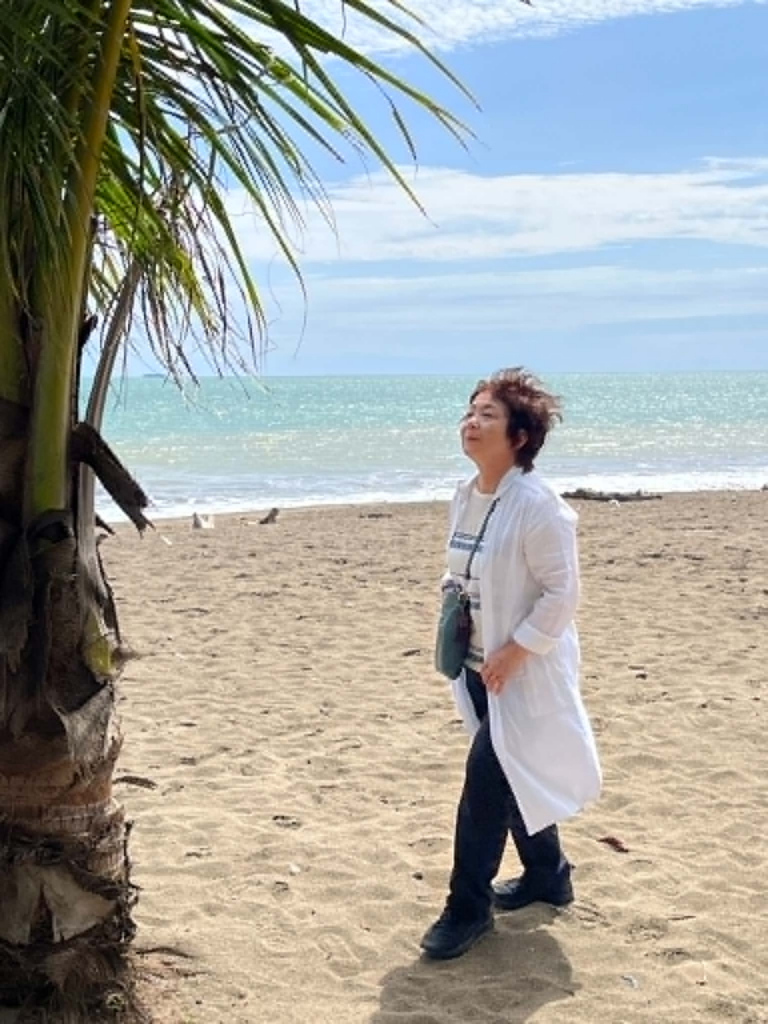
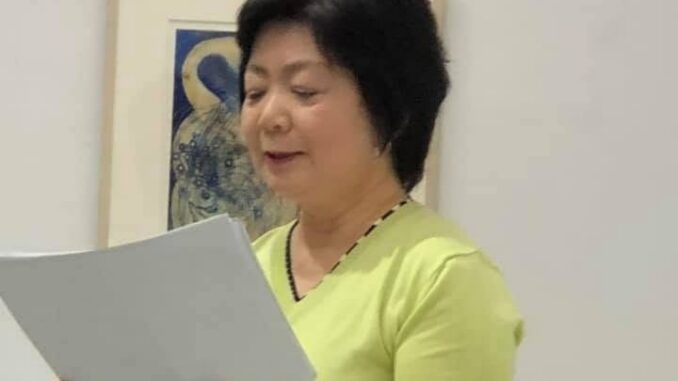
Yumiko Otomasu is a Japanese poet, essayist, and editor, and a member of the Japan Writers’ Association. Born in Kumamoto Prefecture, Japan, she has been an active presence in contemporary Japanese poetry and literary circles for several decades.
From 1982 to 1992, she founded and edited Hi no Naka no Wa (Circle in the Fire), a women’s poetry magazine that provided an important platform for female poetic voices in Japan. Her work has consistently engaged with the intersections of poetry, visual art, performance, community, and social memory.
In 2013, she participated in Words for the Missing Letters, an exhibition responding to the Great East Japan Earthquake. Since 2017, she has been involved in The Poet’s Voice Project, produced by Tendo Taijin, contributing to a long-running series that has now surpassed seventy performances. In 2018, she collaborated with painter Toshihiko Ibe on the two-person exhibition Scales of the Dragon at Gallery Switch Point.
Otomasu’s poetry has reached international audiences through festivals, exhibitions, and readings. She represented Japan at the 15th Buenos Aires International Poetry Festival in 2021 and participated in VOEM’s 33rd performance at Watatsumi Shrine in Tsushima, followed by a poetry reading at the Inudo Kyukei Memorial Hall in 2022. In 2023, she organized and participated in The Riverbank Reading, held in the forest along the Kawabe River in Kumamoto Prefecture. From 2024 to 2025, she has taken part in monthly charity concerts in Hitoyoshi City supporting children’s community kitchens.
Her recent international appearances include the 15th and 16th Ignacio Rodríguez Galván International Poetry Festivals (2025 and 2026) and the 4th International Minangkabau Literacy Poetry Festival (2026).
Her published poetry collections include Waiting for the Yellow Bus (1978), Gloxinia (1989), and Who Is There (2017). Her selected poems have appeared in bilingual and Spanish-language editions, including Scales of the Dragon: Selected Poems 1978–2018 (Japanese–Spanish bilingual edition, 2022) and El relámpago que sueña con el mar: Selected Poems 1978–2018.
Through her writing, editorial work, performances, and international collaborations, Yumiko Otomasu continues to contribute to contemporary poetry as a voice of cultural dialogue, artistic experimentation, and community engagement.
++++
Night
When a person sleeps like a bird,
a bird’s eyes dilate like a person’s.
Stare into the void
and find both past and future
opening out like sky.
There,
the weight, overwhelming—
you might be swallowed up inside.
Stockstill,
you might rest awhile, as a chair does.
Laugh, and you might turn into a flower even—
or, like an echo without original form,
become the voice leaping up into the air.
At such a time, night,
in the form that it is,
without sound,
slips out of morning.
From Gloxinia (Shoshi Yamada, 1989).
+++
Poems by Yumiko Otomasu
trans. Corey Wakeling
The Scales of a Dragon
It has a form
and tail
that slithers above the heavens, rippling and rippling with hot breath
which ripples through the grasses and the trees also
it lets fall
its scales
reason defied
within the rain
When it bites a black cloud, the thunderlight flashes
voice
After it has climbed the heights
a little bridge of rainbow these scales become
A setting sun emitting at horizontal
quaking
is what follows its
lights the scale-shards sprinkled upon a cloud
We call a dragon
everything of this thus changed
On the ground, the people shudder at the dragon
There are no sexes in it
A dragon is not praised
No pity is found in its voice
yet
the timbre of mildness is
only to accept it
One long scaly surface extends from under its jaw
It seems because it bears this part
that a dragon is called a dragon
A dragon claws
with those talons
at this wrath of scales
when it knows by the mirror of a lake’s waters that regrowth arrives
Imitating the undulating shape of the tall mountains
it makes its body wind
But, in truth, the horizontal ground is its preferred shape
and those talons
it polishes upon the mountain cliff megaliths
The water droplets are unremitting in the dancing trail of a dragon
The same droplets carry the power to open holes in boulders
Its form is a vortex
heavens
the haze its target
This its entire form no one can see
However,
the karma of the suffering
will be carried off by the dragon
And so,
passing as it does up through the
at the sight of the anguish of our world
here there are those this will bring enlightenment to
In the hearts of dragon-worshippers
loom
the many-thousand-year-old dragon shadows
Peer out from the heights
base nor lofty
The clouds appear
and people living crawling on the ground look neither
to the shallow
A dragon
heaven’s ocean
Furthermore,
ascending to heaven
even a dragon
and the devoted alike—
knows its smallness
the rain falls
by the greatness of
itself does not know what its destiny holds
From The Scales of a Dragon, an exhibition of poetry and painting by Toshihiko Ibe and Yumiko Otomasu (2018).
+++
Morning Glory
The Sun
removes his shoes.
Sun, King—
at the eastern entrance,
those that crawl upon the earth,
up from downcast eyes, look to his dazzling power.
The Sun
hurries
on bare feet.
Those seeking one thread of light
face up to (they countenance) him.
Light blue,
they puff up their chest
with pride.
From What Lies There (self-published, 2017).
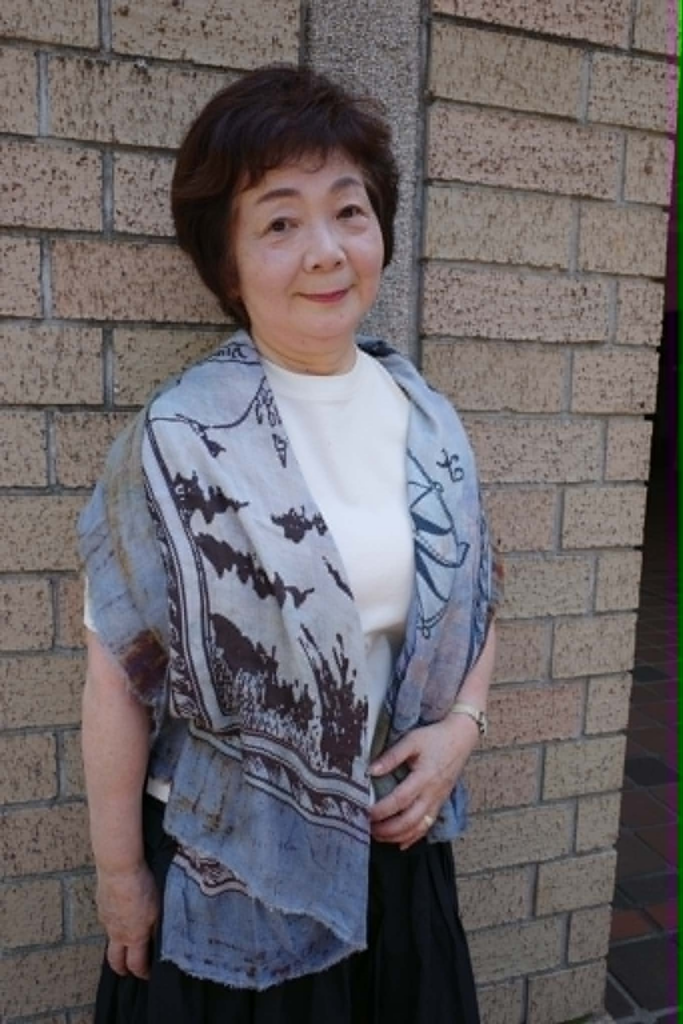
Yumiko Otomasu’s poetry inhabits a luminous space. Love, memory, nature, and spiritual transformation converge. Her work moves fluidly between the intimate and the elemental, creating landscapes in which human emotion is reflected through birds, flowers, rivers, clouds, dragons, nature and senses.
Rather than presenting love as a purely personal or romantic experience, Otomasu expands it into a deeper form of attention, a compassionate engagement with the living world and with the connections that bind people, nature, and time. Her poems are marked by a language of remarkable simplicity and delicacy. Beneath their clear surfaces lies a profound philosophical depth. Everyday images become gateways to mystery: a sleeping bird opens onto reflections of past and future, a morning glory embodies dignity and aspiration, and a dragon becomes a vast metaphor for transformation, suffering, power, and renewal.
Her poetic style is lyrical, contemplative, and imagistic, often drawing upon the traditions of Japanese aesthetics while simultaneously embracing experimental forms, performance, and visual collaboration. Senses play an essential role in her work, inviting readers into states of reflection rather than explanation. Otomasu’s language is never ornamental for its own sake. Instead, it seeks a purity of expression that allows emotion to emerge organically, creating poems that feel both intimate and universal.
Love in her poetry appears as tenderness toward fragile beings, reverence for the natural world, and faith in the possibility of human connection across distances, cultures, and generations. Passion, likewise, is expressed not through dramatic declaration but through attentiveness, wonder, and an enduring commitment to beauty, compassion, and artistic dialogue.
Whether writing of night, flowers, dragons, rivers, or human voices, Otomasu reveals a poetic vision in which all things are interconnected and continuously becoming. Her work invites readers to look beyond appearances, to embrace transformation, and to discover within the ordinary moments of life a profound sense of mystery, resilience, and grace.