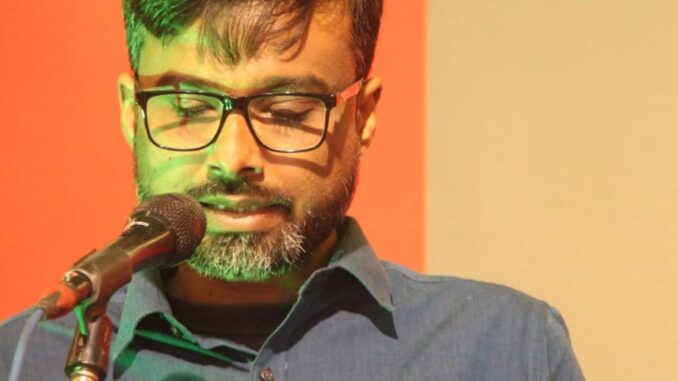
The Music of Words, the Breeze of White Pages
A Bengali poet who turns words into music, absence into poetry, and memory into a paper boat
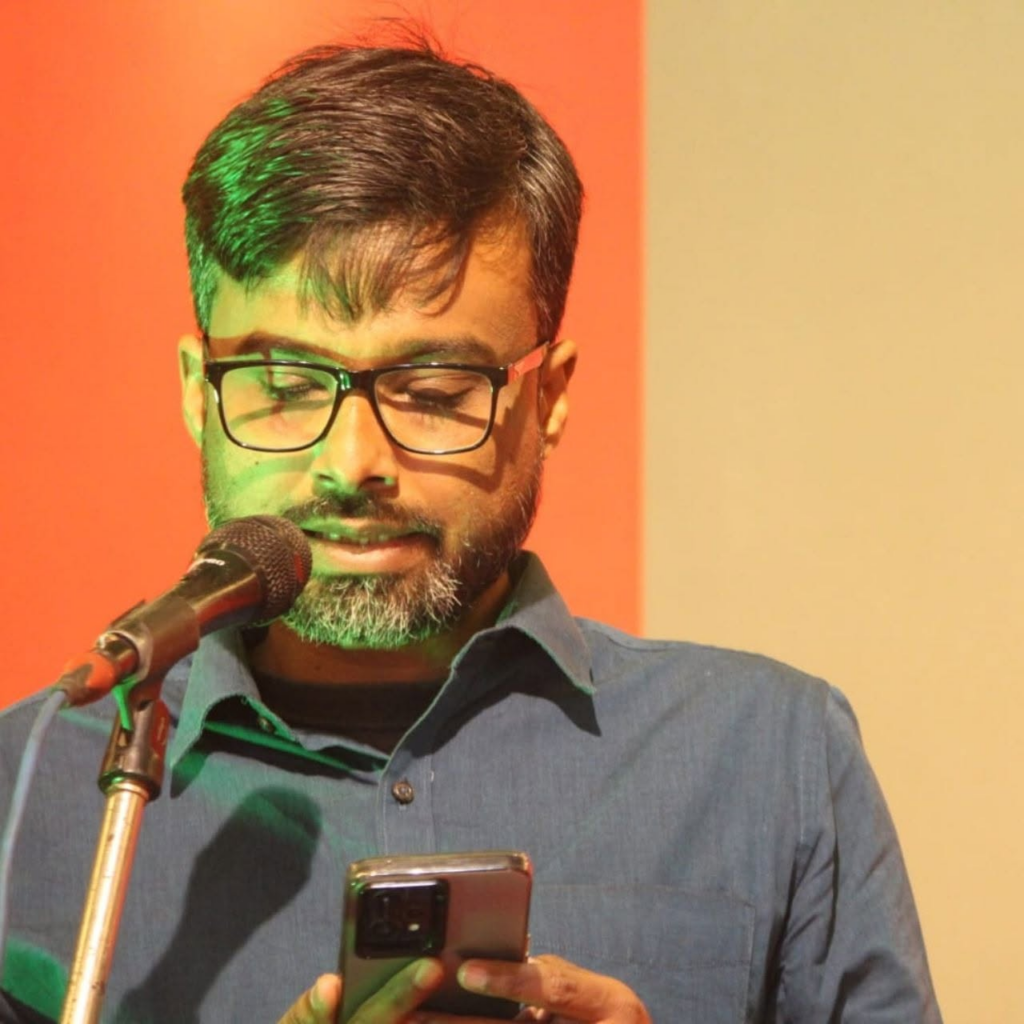
For Abin Roychoudhury, a word can become a guitar string. A poem can become a song. A blank page can become a singer. A firefly can arrive like an intimate companion, disappear without explanation, and leave behind an entire room filled with unwritten letters. His poetry inhabits that delicate territory where the ordinary suddenly becomes mysterious.
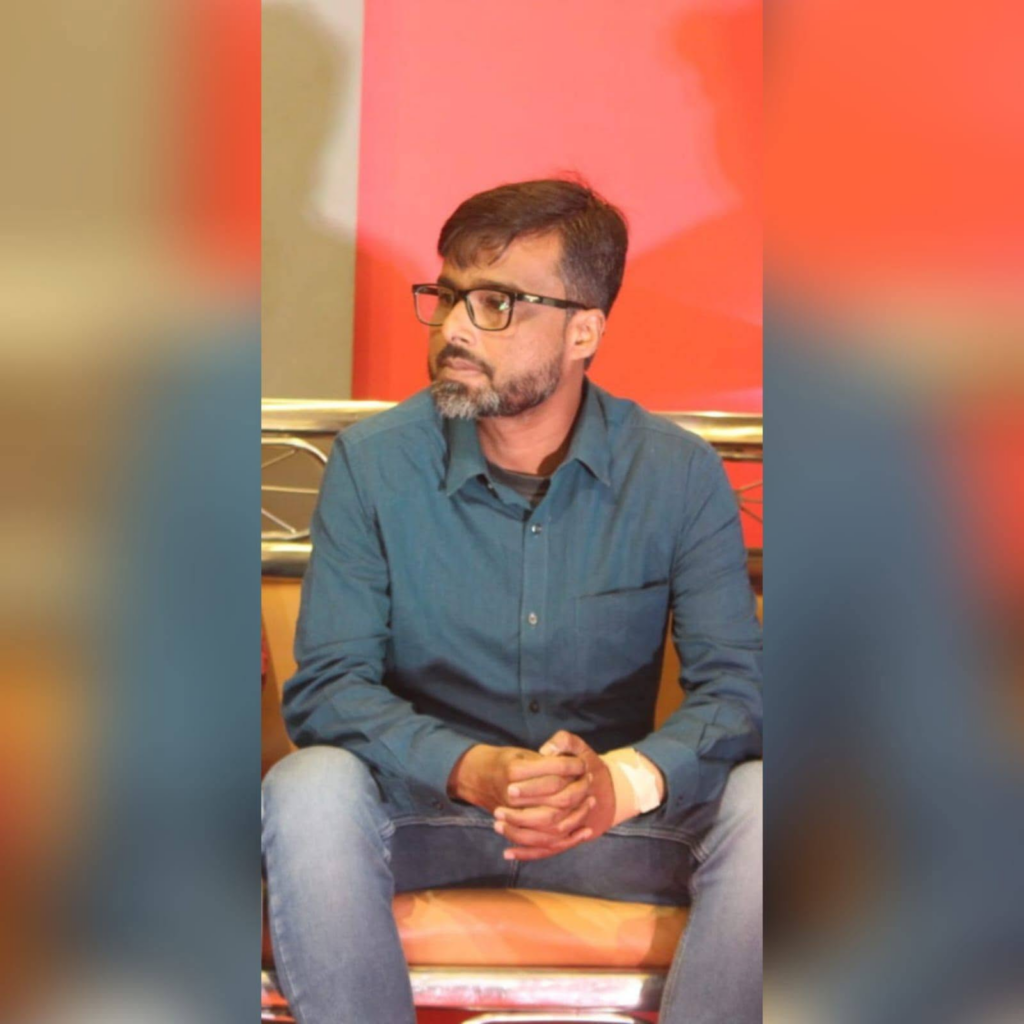
Born on 2 September 1987 in Mangalkote, West Bengal, Abin Roychoudhury is a Bengali poet, essayist, lyricist and writer whose literary journey began remarkably early. He started writing poetry for children’s magazines while still in the fourth grade. Years later, in 2013, he began contributing to established commercial literary magazines, gradually finding his voice within the rich and enduring literary culture of Bengal.
His work is marked by an unusual economy of expression. He does not need elaborate landscapes or grand declarations. A few words are often enough: a father and son, a firefly, a river, a guitar, a blank sheet of paper. Yet within these simple images reside questions of time, memory, absence, identity and human connection. His poems frequently begin in the familiar and end somewhere unexpected. That movement from the everyday toward the philosophical is one of the defining qualities of his poetry.
In Abin Roychoudhury’s poetic world, words have sound. They have rhythm. They possess the capacity to become music. This idea is beautifully expressed in his poem “Symphony,” every word is imagined as an instrument, and every poem becomes a song surrounded by the breeze. The poet sees the white space around the poem acquires a presence of its own. The poem sings and so does the breeze surrounding it.
This sensitivity to sound perhaps also explains Roychoudhury’s connection with lyric writing. He is the lyricist of the widely popular song “Norom Sobdo Chunye Dao,” a work that has reached listeners through major global music platforms. His engagement with poetry therefore extends naturally beyond the printed page, moving between literature, performance and song.
His poetry has been presented at the Krittibas Poetry Festival and the India–Bangladesh Poetry Festival, and he has also performed for All India Radio. His poems have appeared in Desh, one of Bengal’s most respected literary magazines, as well as in Bharat Bichitra, the Bengali literary monthly published by the High Commission of India in Dhaka. His literary work has also received attention from Anandabazar Patrika and other media and literary platforms, including Artista De Colores and World Inkers.
Before choosing poetry as a full-time vocation, Roychoudhury spent nearly six years teaching at two B.Ed. colleges. That experience adds another dimension to the story of his literary life. Teaching and poetry may appear to belong to different worlds, but both demand an intimate engagement with language, imagination and human experience. Eventually, he left academia to devote himself fully to poetry. His debut poetry collection, Itipurbe Bolini, was published by Ananda Publishers, one of India’s leading publishing houses, a significant achievement, particularly for a debut poet. His subsequent collections include Golap Nirapekkha Noy and Bibarna Cycle. He is also the recipient of the Mallika Sengupta Smriti Puraskar, a recognition that places his work within the continuing conversation of contemporary Bengali poetry.
>><<>><<>><<>><<
THREE POEMS BY ABIN ROYCHOUDHURY
The following English versions were translated from the original Bengali by Alok Biswas.
I. Symphony
Abin Roychoudhury
The words in my poems are strings of a guitar,
even the reeds of a harmonium.Each word carries the music of a flowing river,
the cry of a mountain,
the rage of the trees.Each of my poems is a song,
and around it lies
the blank white pages—
and their singers…
Symphony is a small poem with a large musical imagination. Roychoudhury begins with an apparently simple metaphor: the words of a poem are compared to the strings of a guitar and the reeds of a harmonium. But the metaphor quickly expands. The individual word begins to contain an entire landscape. The river has its music. The mountain has its cry. The trees have their rage. Nature, in this poem, possesses a voice, an emotion, even an instrumentality. The poet’s task is perhaps not to create those sounds, but to hear them and transform them into language. The final image is particularly striking the blank white pages, and their singers. The poet reverses the conventional relationship between poem and page. Normally, the written poem is considered the meaningful object while the empty page is merely its background. Roychoudhury gives the blank page a voice of its own. The breeze around the poem becomes part of the poem. And perhaps that is where the title Symphony finds its deepest meaning: a symphony is not made only from individual notes, but from the relationship between sound and silence.
II. The Point
Abin Roychoudhury
Till now I haven’t been able to solve
the equation of the father and the son.How could I possibly solve it?
The father and the son
are the same age.
There is an extraordinary simplicity to The Point. At first glance, it resembles a miniature mathematical puzzle. A father and son. An age equation. A problem that refuses to be solved. Then comes the final line: The father and the son are the same age. Suddenly, the mathematics disappears and something much more human takes its place. The poem may be read as a meditation on time and inheritance. A father and son occupy different generations, yet in memory they can become strangely contemporaneous. A son may carry his father’s youth within himself; a father may remain forever the age at which his child remembers him. The poem’s power comes precisely from what it does not explain. It leaves the reader with a paradox. How can a father and son be the same age? Perhaps they cannot in the literal arithmetic of life. But poetry is not always concerned with literal arithmetic. Memory has its own mathematics. Love has another. And grief, perhaps, has none at all. In only a handful of lines, Roychoudhury turns an apparently impossible equation into a meditation on family, time and the strange ways human beings continue to inhabit one another.
III. Stream
Abin Roychoudhury
A certain firefly comes to me every night.
I call it by its nickname.
We sleep together.
Then, one morning,
suddenly, it flies away
and never returns to me.Since then, my room has become
the blank white page
of a letter the firefly never wrote.With that white page,
I make a paper boat
and set it afloat
upon the waters of my poems…
Among these three poems, Stream perhaps reveals most clearly the emotional architecture of Roychoudhury’s poetry. It begins with intimacy. Every night, a firefly comes to the poet. He has a nickname for it. They sleep together. The language is deliberately gentle, almost childlike. There is nothing grand or dramatic about the relationship. It is simply the quiet presence of something small and luminous that has become part of the poet’s life. Then, without warning, the firefly disappears. It never returns. And from that absence comes the poem. The poet’s room becomes the blank white page / of a letter the firefly never wrote. This is a beautiful image because the absence is not represented by darkness but by whiteness. The blank page itself becomes a record of loss. Then comes the poem’s final transformation: the poet takes that unwritten letter and folds it into a paper boat. He sets it afloat on the waters of his poems. The image creates a quiet circle. Something has been lost, but the loss itself becomes poetry. The unwritten letter becomes a boat. The boat enters the stream. The stream becomes the poem. The firefly is gone, but its absence continues to travel. Perhaps this is one of the essential mysteries of poetry: what disappears from life can sometimes become most permanent in language.
The Poet
Abin Roychoudhury was born on 2 September 1987 in Mangalkote, West Bengal, India. He is a Bengali poet, essayist, lyricist and writer. He began writing poetry for children’s magazines in the fourth grade and later began contributing to commercial literary magazines in 2013. He taught at two B.Ed. colleges for nearly six years before leaving academia to pursue poetry full-time. His debut poetry collection, Itipurbe Bolini, was published by Ananda Publishers. His other poetry collections include Golap Nirapekkha Noy and Bibarna Cycle. As a lyricist, he wrote the lyrics for the popular song “Norom Sobdo Chunye Dao,” which is available through major international music platforms. He has regularly participated in the Krittibas Poetry Festival and the India–Bangladesh Poetry Festival, and has also performed for All India Radio. His poems have appeared in Desh and Bharat Bichitra, among other literary publications. His work has also been featured by Anandabazar Patrika, Artista De Colores, World Inkers and other media and literary platforms. He is the recipient of the Mallika Sengupta Smriti Puraskar. He lives in Panuhat, near Katwa, West Bengal.