
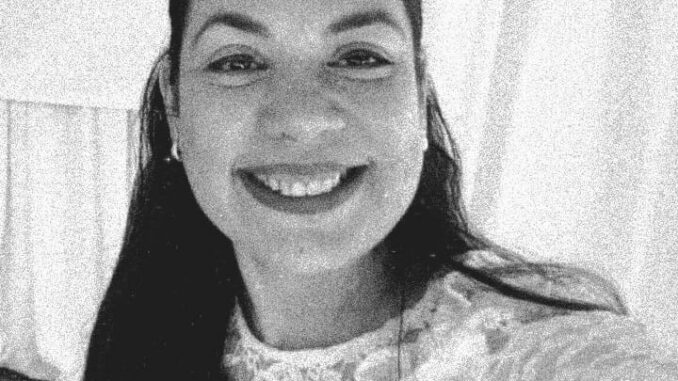
Mirih Berbin
Born in Bolívar State, Venezuela, in 1983, Mirih Berbin has lived in Valencia for more than a decade. She is a poet, editor, translator, cultural promoter, and educator whose work brings together literature, language, education, and cultural exchange.
Berbin holds a Master’s degree in Reading and Writing and a Bachelor’s degree in Education, specialising in English, both from the University of Carabobo (UC). She is currently an assistant professor in the Department of Modern Languages at the UC School of Education and has also worked in the university’s Department of Philosophy. She is a member of the Writers’ Circle of Venezuela (Círculo de Escritores de Venezuela).
Her literary and cultural work includes serving as associate editor of the literary publication El Diente Roto and as a translator at international poetry festivals. She has published articles on language teaching and philosophical approaches to education, and has delivered more than 20 papers and lectures on educational and pedagogical topics. She also led the poetry workshop Cuando expreso todo lo que habito (“When I Express All That I Inhabit”), organised by the Mayor’s Office of Puerto Cabello and the Autonomous Municipal Institute of Culture.
Berbin was featured in Laura Antillano’s book Ellas (2013), and her poetry has appeared in numerous literary journals and anthologies. She was a cultural columnist for the weekly section of Diario La Costa from 2009 to 2011 and later contributed to Ciudad Valencia from 2024 to 2025.
She is the author of Mareas (2009), Hacerme Templo (2016), and Hilos Nacientes (2026). Her poetry has been translated and published in Arabic, French, and English, extending her work to readers and literary communities beyond Venezuela.
Through poetry, translation, education, and cultural promotion, Mirih Berbin continues to contribute to Venezuela’s contemporary literary landscape while fostering dialogue across languages and cultures.
+++
Binnacle of the redeem oneself
Outside there is an absence of messages
for people like me.
Bodies that swing
every of those beings that we take care
In the past, every coordínate suggested another journey
The overjoy to frame the words
in the ink of the road
grottos bordering landscapes and letters
shadows and words
lights and lightings
but every of those movements
have a watch breathing
just right back of the left ear.
The sounds are getting closer,
the steps, the inqueering,
given to turn back the day
the invitation to turn back the ideas
for people like me
who have no more way out
than forgiving ourselves
to have stopped asking
if outside is less heavy
at least a little less.
Mirih Berbin
***
To hold ourselves together
We need to believe in the verse,
appeal to the day
to the words
substanced of calmness and sanity
I have invented an afteernoon to myself
searching meanings and shapes
in lined up fractions
walking barefoot of corners
we need to believe in the verse,
in the poem, ourselves and the days
Where I come from, Venezuela
the concrete fell appart
taking away with it half of our city.
Paralyzing every Venezuelan heart
We made a stop to the rest,
even to our own tribulations.
We turned the break in help
and all the colors and all the flats
have come to stir up the rubble
Little by little, our hearts are beating again of gratitude, because today, more than ever, I say it.
To hold ourselves together, we need to believe in the verse.
Mirih Berbin
***
Almost transparent
The curtains have moved
the water when spills
don’t take a form of woman’s body
nor even the word
take a form of only body
or the silence take any form
So the absolute denial
is the antithesis of the corporeal
the rupture
of what seems to be so distant
is consummate it… all!
the curtains are almost transparent
decoratives are those words
bills in the water
bills in the sky
the transparence is in essence mine
I undress with clothe of without it
the clothe is the curtain that lets you see the window
but doesn’t show the skin
or the water
or the bill
or the sky.
Mirih Berbin
***
Mirih Berbin’s poetry moves through landscapes of memory, displacement, uncertainty, tenderness, and renewal, creating a deeply intimate language that is at once personal and collective. In Binnacle of the redeem oneself, the poet explores the emotional weight of being among those who carry responsibility for others, while confronting the exhaustion of bodies, memories, journeys, and questions that seem to have no easy destination. Her imagery of coordinates, roads, caves, shadows, light, sounds, and footsteps gives the poem the feeling of an inward voyage, where movement through the external world becomes inseparable from an examination of the self. The presence of something breathing just behind the ear introduces a subtle sense of unease, suggesting that memory, fear, conscience, or unresolved experience can accompany us even when we believe we have moved forward. Yet the poem ultimately turns toward forgiveness, presenting self forgiveness not as surrender but as a necessary form of survival when there appears to be no other way out.
In To hold ourselves together, Berbin shifts from individual reflection toward a shared Venezuelan experience, placing poetry itself at the centre of resilience. The verse becomes a means of believing in the possibility of recovery when the physical and emotional structures of a community have been shaken. The poem evokes the collapse of the concrete city and the devastation left behind, but it also recognises the solidarity that emerges in moments of crisis, when people pause their own suffering to help others and transform a rupture into an opportunity for care. Her repeated return to the need to believe in the verse gives the poem a quietly powerful rhythm, suggesting that poetry can become a form of shelter, connection, and collective memory. The poem therefore carries both grief and gratitude, acknowledging the damage experienced while celebrating the return of hope and the possibility of rebuilding together.
Almost transparent enters a more abstract and sensual space, where curtains, water, sky, words, silence, clothing, and the body continually approach one another without becoming fully defined. Berbin questions the boundaries between what can be seen and what remains hidden, using transparency as a metaphor for identity and vulnerability. The body appears as something that cannot be completely contained by language, while the curtain becomes an intermediary between exposure and concealment, allowing the possibility of being seen without surrendering everything that lies beneath the surface. Across these three poems, Berbin demonstrates a poetic sensibility attentive to both the fragile interior life of the individual and the larger realities that shape collective experience. Her work moves between the visible and the invisible, the personal and the communal, rupture and renewal, making poetry a space where memory can be carried, pain can be transformed, and the self can learn to remain present.

Thank You very much for the reading