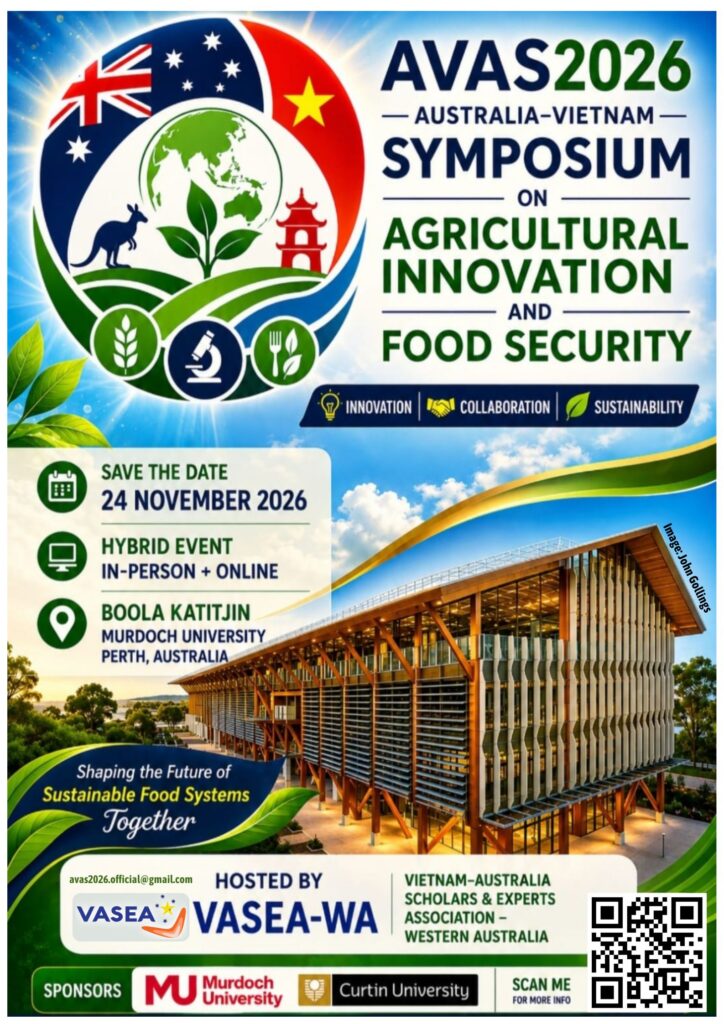

Perth, Western Australia — 27 August 2026 — The Vietnam-Australia Scholars & Experts Association Western Australia (VASEA WA) welcomed Professor Nguyen Van Thanh and his delegation to Curtin University for a program of academic exchange exploring some of the key challenges and opportunities shaping the future of sustainable development. (VASEA WA) welcomed Professor Nguyen Van Thanh and his delegation to Curtin University for a program of academic exchange exploring some of the key challenges and opportunities shaping the future of sustainable development.
Held at Curtin University’s Bentley campus, the visit brought together Vietnamese and Australian perspectives on sustainable finance, ESG, carbon markets, smart cities, digital transformation and the transition towards net zero.
The delegation was led by Professor Nguyen Van Thanh, who has held a number of senior leadership positions in Viet Nam, including Chairman of the Hai Phong City People’s Committee, Secretary of the Hai Phong City Party Committee, Deputy Minister of Public Security, and Vice Chairman of the Central Theoretical Council from 2021 to 2026.
The delegation also included Mr Ky Cao, President of the National Australia Vietnam Chamber of Commerce and Industry (NAVCCI).
The academic program was organised across Curtin’s Faculty of Business and Law and School of Electrical Engineering, Computing and Mathematical Sciences (EECMS), providing an opportunity for participants to share knowledge, compare experiences and identify potential areas for future collaboration.
Sustainable Finance, ESG and Carbon Markets
The first roundtable discussion, hosted by Associate Professor Lien Duong at Curtin’s Faculty of Business and Law, focused on sustainable finance, environmental, social and governance (ESG) considerations, carbon markets and the broader transition towards a low-carbon economy.
Professor Nguyen Van Thanh delivered a presentation on greenhouse gas (GHG) management in accordance with ISO 14064-1 and ISO 14064-2, sharing perspectives on approaches to measuring, reporting and managing greenhouse gas emissions.
The discussion then explored developments in Viet Nam’s carbon-market landscape, climate-related financial disclosures and the country’s energy transition. Associate Professor Lien Duong shared insights into how these developments are connected to wider sustainability objectives and the United Nations Sustainable Development Goals (SDGs).
The exchange highlighted the importance of effective policy settings, financial mechanisms, reliable emissions measurement and institutional capability in supporting the transition to a more sustainable economy.
The Australian and Vietnamese participants also considered how knowledge, standards and international cooperation can contribute to building greater capacity for sustainable finance and carbon-market development.
Smart Cities, Sustainable Living and Digital Twins
The second session moved to the School of Electrical Engineering, Computing and Mathematical Sciences, where Associate Professor Sonny Pham and Associate Professor Himanshu Agrawal hosted a discussion on smart cities, sustainable living and digital twins.
Associate Professor Sonny Pham welcomed the delegation and introduced Curtin’s research capabilities and initiatives relating to sustainable living in Western Australia.
Particular attention was given to the Pathway to Net Zero Precincts (NZP) project, undertaken as part of the RACE for 2030 Cooperative Research Centre (CRC). The project examines how precincts can transition towards net zero while addressing the practical challenges associated with energy, infrastructure, technology, communities and stakeholder engagement.
The Curtin Bentley campus serves as one of the project’s case studies, representing a mixed-use precinct among eight sites investigated through the initiative.
Associate Professor Himanshu Agrawal provided a deeper overview of the NZP project’s implementation journey, including engagement with multiple stakeholders and the challenges involved in translating sustainability ambitions into practical outcomes.
A key theme was the role of digital twins in bringing together and visualising complex data to support planning, monitoring and decision-making. By providing a digital representation of physical environments, digital-twin technologies have the potential to help governments, businesses and communities better understand the impacts of proposed changes and develop more informed responses.
The project team expects to complete its final report in the coming months, with findings intended to support recommendations for government and industry.
The Triple Helix Approach to Innovation
The discussion also explored the CRC and Triple Helix models, which bring together government, industry and universities to collaborate on complex real-world challenges.
Professor Thanh expressed particular interest in this collaborative approach, emphasising that successful transitions require consideration of the different stakeholders and communities affected by changes in the way people live and work.
The discussion recognised that technological and environmental transformation cannot be considered solely from an infrastructure or technology perspective. People, skills, communities and workforce capability are equally important to achieving successful and inclusive transitions.
Associate Professor Lien Duong complemented the discussion by sharing perspectives on capability-building and workforce retraining, highlighting the need to ensure that people are supported as economies and workplaces evolve.
This people-centred dimension added an important social and economic perspective to discussions around net zero, smart cities and digital transformation.
Hai Phong’s Smart and Green Port City Vision
Professor Thanh subsequently shared insights into the transformation of Hai Phong as a smart and green port city.
Drawing on his experience in senior leadership in Hai Phong, Professor Thanh presented a systematic perspective on smart-city development and the importance of using internationally recognised standards and indicators to assess urban performance.
Among the frameworks discussed was ISO 37120, which provides indicators covering multiple dimensions of city services and quality of life.
Professor Thanh also reflected on his involvement in the development of international approaches to smart-city evaluation, providing a valuable perspective on the challenges of translating global standards into practical urban-development strategies.
The exchange demonstrated strong alignment between the experiences of Western Australia and Viet Nam, particularly in relation to the development of sustainable, digitally enabled and future-ready cities.
Curtin Campus Innovation Tour
The academic sessions concluded with a guided tour of Curtin University’s Bentley campus.
The tour provided the delegation with an opportunity to experience the campus environment and observe examples of Curtin’s approach to innovation, sustainability and future-ready precinct development.
The visit also connected the academic discussions with the physical environment in which many of the ideas being explored — from sustainable infrastructure and energy management to smart technologies and precinct-scale planning — are being tested and developed.
Strengthening Australia–Viet Nam Collaboration
The visit provided a valuable platform for dialogue between Vietnamese and Australian academics, practitioners and institutional representatives.
Across the two sessions, participants explored the interconnected nature of today’s major development challenges. Sustainable finance requires credible emissions measurement; the transition to net zero requires technological innovation and workforce capability; and smart-city development requires not only digital infrastructure but also effective governance, community engagement and international standards.
The discussions also highlighted the value of collaboration between universities, government and industry in translating research and knowledge into practical solutions.
For VASEA WA, the visit represents an important contribution to its mission of strengthening and contributing to the relationship between Viet Nam and Australia.
The conversations at Curtin University have opened opportunities for further engagement and potential collaboration in areas including sustainability, green finance, carbon markets, smart cities, digital transformation, workforce capability and research translation.
As both Australia and Viet Nam pursue ambitious economic, environmental and technological transformations, exchanges such as this provide an important foundation for sharing experience, building institutional relationships and developing practical partnerships.
VASEA WA looks forward to continuing these conversations and supporting further connections between Vietnamese and Australian universities, government, industry and community organisations.
The Vietnam-Australia Scholars & Experts Association (VASEA WA) continues to play an important role in strengthening connections between Viet Nam and Australia by creating platforms for dialogue, knowledge exchange and practical collaboration. Through initiatives such as this academic visit to Curtin University, VASEA WA brings together scholars, experts, academics, industry representatives and community stakeholders to explore shared opportunities and address common challenges. The Association remains committed to fostering long-term partnerships and supporting collaboration across education, sustainability, innovation, technology and green economic development, contributing to stronger and mutually beneficial ties between Viet Nam and Australia.