
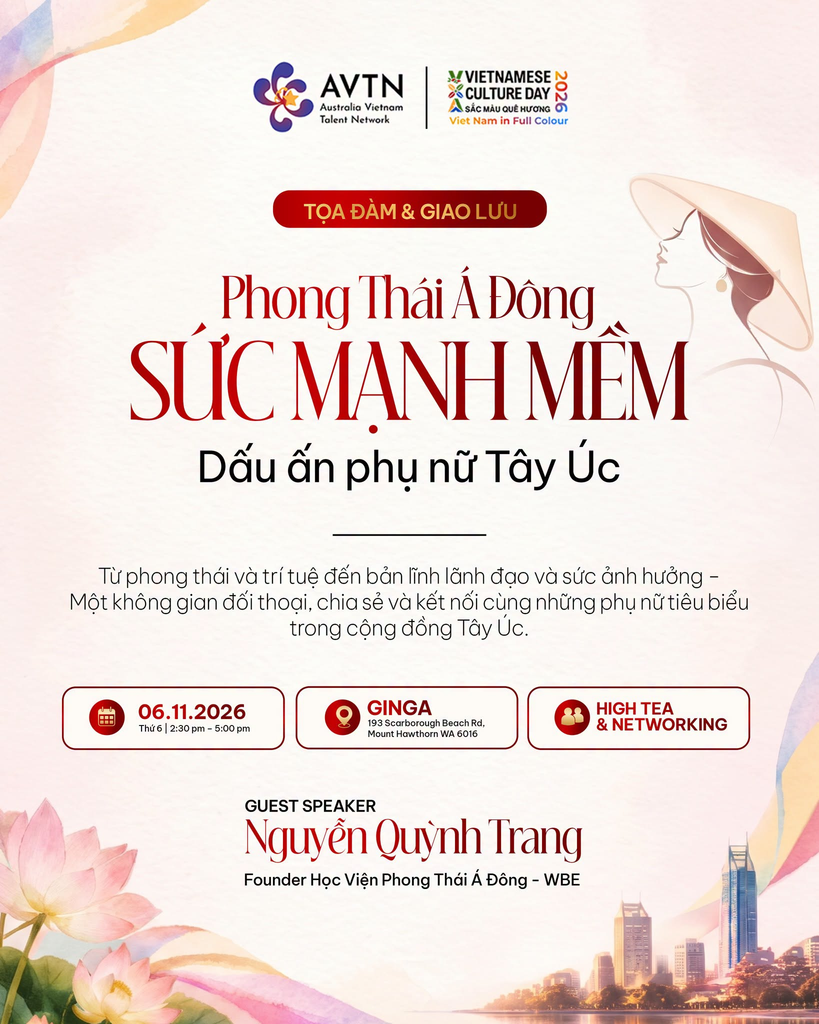
The afternoon of 6 November 2026 brought together a vibrant gathering of Vietnamese women and friends at Ginga, a charming café located on Scarborough Beach Road in Mount Hawthorn, Perth. The event, Phong Thái Á Đông – Sức Mạnh Mềm (Eastern Elegance – The Power of Softness), was organised as part of Vietnamese Culture Day 2026 by the Australia Vietnam Talent Network (AVTN). The café offered a welcoming setting for high tea and networking, while a thoughtfully arranged workshop space at the back provided an intimate environment for conversation, learning and the exchange of ideas. Beyond its elegant atmosphere, the gathering was distinguished by the diversity of its participants, whose professional backgrounds and personal experiences reflected the many dimensions of Vietnamese women’s contributions to Australian society.
Following the introductions and warm exchanges among participants, attention turned to Phuong Le and the central message of the afternoon: the meaning of soft power, feminine presence and the influence women can exercise through their knowledge, character, confidence and relationships.
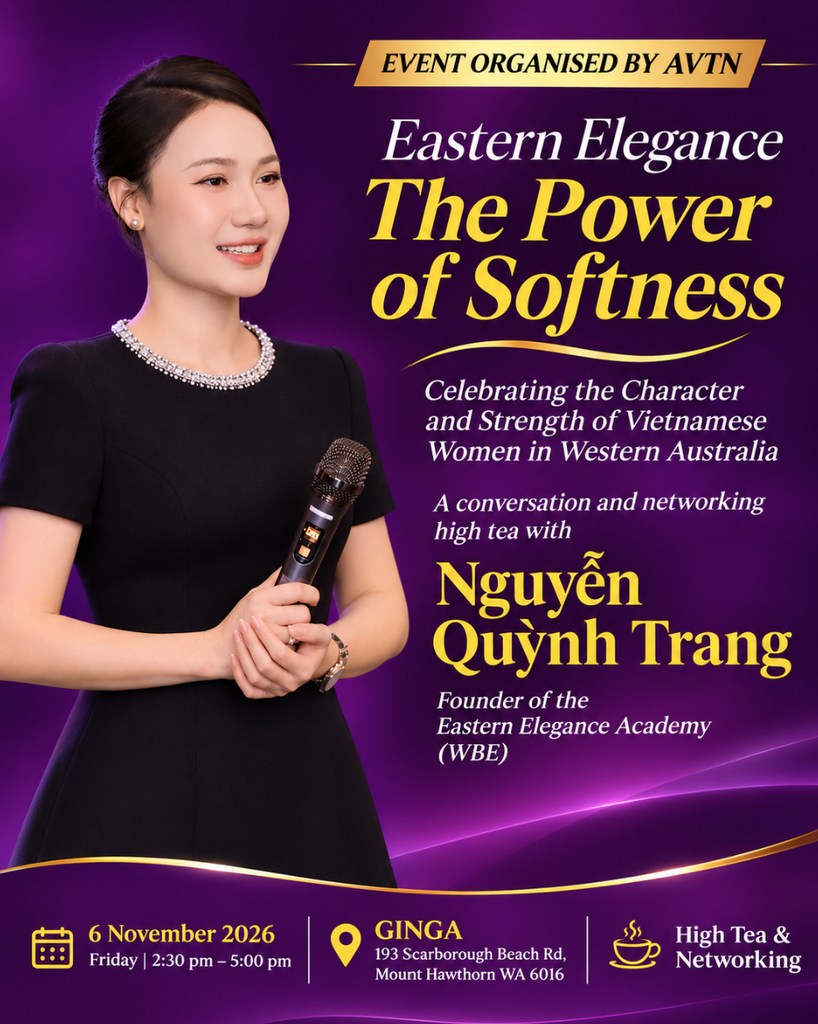
The central presentation of the afternoon was delivered by Nguyễn Quỳnh Trang, Founder and CEO of Học viện Phong Thái Á Đông (WBE), whose work focuses on developing personal elegance, social etiquette and the inner qualities that shape an individual’s presence. An international trainer in personal elegance and social protocol, and a graduate of the London College of Fashion, Trang has pioneered structured programmes in body aesthetics and elegant presence in Vietnam. With nearly a decade of experience and more than 30,000 learners reached nationwide, she has worked with women, young people, educational institutions, banks and major corporations. Her appearance in Perth formed part of the academy’s contribution to Vietnamese Culture Day 2026, bringing a distinctive perspective on the role of feminine character, intelligence, leadership and cultural identity within the Vietnamese community in Western Australia.
Rather than beginning with a conventional lecture, Trang invited everyone to consider a simple question: when meeting someone for the first time, what leaves the strongest impression? Participants offered answers such as personal elegance, confidence, communication, body language and clothing. Their responses provided a natural introduction to her central philosophy: consistency. True elegance requires harmony between what we think, what we believe, our personal values and the way we express ourselves. Intelligence, awareness, character and outward behaviour should not contradict one another. A person’s presence becomes convincing when the inner self and external expression are aligned.
Trang introduced an interesting perspective on the relationship between inner qualities and outward appearance, suggesting that 80 per cent of personal elegance comes from within and 20 per cent from external presentation. The emphasis was not on numerical measurement but on the importance of substance. Intelligence, consciousness, personal values and character form the roots, while communication, behaviour, body language and clothing reveal those qualities to the world. She reminded participants that people can disadvantage themselves when they fail to recognise and develop the strengths they already possess. Elegance, therefore, is a continuous process of learning, nurturing and refining oneself. It is about becoming beautiful from within and allowing that beauty to find its natural expression.
One of her memorable comparisons was that good wood needs good paint: an attractive exterior cannot compensate for a weak foundation. Clothing, she explained, is also a personal calling card. It communicates identity, profession, awareness and respect before a person has even spoken. However, dressing well is only one aspect of personal presentation. Learning how to express oneself through language, gestures, facial expressions and social interaction is equally important. Interestingly, she also explored the relationship between the external and internal worlds: improving the way we present ourselves can positively influence how we feel, think and behave. Treating ourselves with kindness and respect helps nurture confidence, health, beauty, attractiveness and the ability to create a positive influence on others.
Trang’s own professional journey added a personal dimension to her message. Before becoming an educator and trainer in elegance and etiquette, she had worked in the spa industry and subsequently moved into the fashion business, including her experience with M2, before pursuing further studies overseas. Her journey reflects an evolution from the worlds of beauty and fashion towards a more comprehensive understanding of personal development, cultural awareness and human interaction. Her message was that elegance should never be regarded as an expensive appearance or an exclusive privilege. It is something that can be learned, practised and cultivated through everyday choices.
She further expanded the discussion to include happiness, family and relationships. Happiness, in her view, begins within and grows through the way we share, care for one another and build our relationships. The family is an important environment in which values and manners are formed. Parents, in particular, are role models for their children; their words, conduct and everyday behaviour influence how the next generation understands respect, responsibility and relationships. The discussion of harmonious marriage and family management brought the concept of elegance beyond individual appearance, placing it within the broader context of living well with others.
For professional and business environments, Trang highlighted the value of personal presence in leadership. Credibility, reputation and professionalism are not established by titles alone but are reflected in the way leaders communicate, make decisions and treat people. A company’s culture cannot simply be copied from another organisation; it must be cultivated through its own people, values and shared practices. Personal elegance and professional conduct can influence workplace relationships, the quality of human resources, mutual respect and even opportunities for career advancement. In this sense, refined manners are not superficial formalities but valuable elements of a healthy professional environment.
To make her philosophy more practical, Trang introduced five pillars of Eastern elegance. The first, Hình thể, concerns physical presence and the foundations of personal presentation and etiquette. The second, Vũ họa phong thái, explores the art of graceful presence: softness like a lily, yet supported by strength and resilience within. The third, Hiện diện, focuses on the way we carry ourselves through standing, sitting and walking, recognising that presence communicates even before words are spoken. The fourth, Phong thái giao tiếp, concerns communication through language, eye contact, facial expressions and body language. The fifth, Phong thái lễ nghi, emphasises social etiquette, appropriate conduct and the ability to interact respectfully in different settings. Together, these pillars offer a practical framework for developing a presence that is both graceful and grounded.
Perhaps the most far-reaching aspect of her presentation was the idea of creating and nurturing a distinctive Vietnamese cultural identity through elegance. This begins with the individual, extends into the family, takes shape within organisations and eventually contributes to society. Trang’s vision was not simply to teach women how to dress or behave elegantly, but to encourage a more thoughtful and confident expression of Vietnamese identity in an increasingly interconnected world. She also emphasised that this knowledge should reach beyond women. Men and young people, particularly the next generation, can benefit equally from learning the values of communication, etiquette, self-respect and cultural awareness.
Throughout her presentation, the concept of Sức Mạnh Mềm – the power of softness – emerged as something much deeper than gentleness or appearance. Softness does not mean weakness. It can coexist with intelligence, discipline, confidence and inner resilience. True elegance is not about performing for admiration or following a prescribed image. It is about cultivating the roots of one’s character, expressing personal values consistently and creating a positive influence wherever one goes. In Trang’s philosophy, the art of elegance begins within, but its influence reaches far beyond the individual.
The gathering also reflected the vision of Hannah Huyền Vũ, Founder and President of the Australia Vietnam Talent Network (AVTN), the organisation behind the event. Beyond her leadership of AVTN, Hannah serves as Director of External Relations (Southeast Asia) at The University of Western Australia, where her work is closely connected with international engagement and Australia–Vietnam relations. Her vision extends beyond bringing people together; it is about building meaningful bridges between cultures, generations, universities, businesses and communities. Through AVTN, she seeks to nurture a new generation of globally minded Vietnamese leaders who are confident, capable and connected, while creating opportunities for knowledge exchange, professional development and cross-cultural collaboration. Her presence and leadership provided an important organisational context for an afternoon dedicated to women’s influence, personal development and community connection.


Leave a Reply