Day 3: ISISAR: A LIVING DIALOGUE OF CIVILIZATIONS
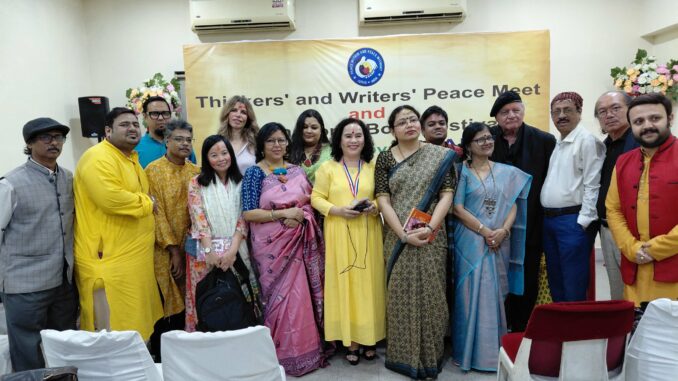
The final day of the World Thinkers’ and Writers’ Peace Meet and International Book Festival 2026 was busy with vibrant energy and thoughtful engagement at Rotary Sadan in Kolkata. The three-day gathering organised by the International Society for Intercultural Studies and Research (ISISAR) reached its culminating moment through a rich sequence of cultural celebration, literary dialogue, and international poetic exchange. From early afternoon until late evening, audiences moved through halls alive with music, ideas, and recitation, creating a memorable closing chapter for the festival.
The afternoon began with a cultural programme inspired by the spirit of Holi. Colour, rhythm, and joyful music filled the hall as artists celebrated one of India’s most beloved festivals. Holi carries the symbolism of renewal, shared happiness, and human connection. Within the context of an international literary gathering, the celebration reflected the festival’s broader theme of unity across cultures. Laughter, applause, and rhythmic movement created a welcoming atmosphere that carried warmth through the rest of the day.
The literary momentum continued during the book discussion and poetry reading session coordinated by Shyamal Bhattacharya. Distinguished guests and writers gathered to share reflections and readings that explored literature’s influence across societies. Among the respected figures present were Sitanshu Yashaschandra, a Padma Shri and Sahitya Akademi Award recipient, Kamal Vora, and Joba Murmu, together with Garry James, Srinivasa Rao Sambangi, Padmaja Iyengar (Paddy), and Muniam Alfaker. Their discussions touched upon the movement of literature across regions, the preservation of cultural memory, and the vitality of poetic expression in contemporary times. Poetry readings enriched the discussion and filled the hall with reflective silence and appreciative applause.
Simultaneously, several literary sessions took place across different halls of the venue. Hall 2 hosted the ISISAR–Virasat literary session coordinated by Rituparna Khan, while another gathering focused on Assamese literature under the guidance of Gitanjali Himanka. These sessions highlighted regional literary traditions while connecting them to the wider international dialogue unfolding throughout the festival.
One of the most engaging gatherings of the afternoon during the collaborative literary session between ISISAR and Na Hanyanate, coordinated by poet and translator Mahua Das. Na Hanyanate has cultivated literary and cultural activity for nearly two decades, and its collaboration with ISISAR created an atmosphere of thoughtful exchange and artistic sincerity.
The programme commenced around 4:40 PM with a welcoming address by Mahua Das, whose introduction set an attentive and reflective tone. An opening song followed, creating a gentle and lyrical beginning for the session. Soon afterwards, the Vietnamese poets Hong Hanh and Duy Pham presented songs that touched the audience deeply. Their voices are filled with emotion that travelled across linguistic boundaries and resonated with listeners throughout the hall.
Poetry recitation formed the next part of the programme. Distinguished poets and writers including Hindol Bhattacharya, Rajaditya Bandyopadhyay, Indrajit Mitra, Debargha Saha, Shamik Joy Sengupta, and Ranjana Roy presented their work with expressive conviction. Each reading introduced a distinctive voice and emotional landscape. The atmosphere grew richer as accomplished elocutionists Shuvadeep Chakraborty, Koushani Kundu, Bibekananda Hazra, and Susmita Roy brought poetic texts to life through powerful vocal interpretation and dramatic expression. Their performances added resonance and depth to the gathering.
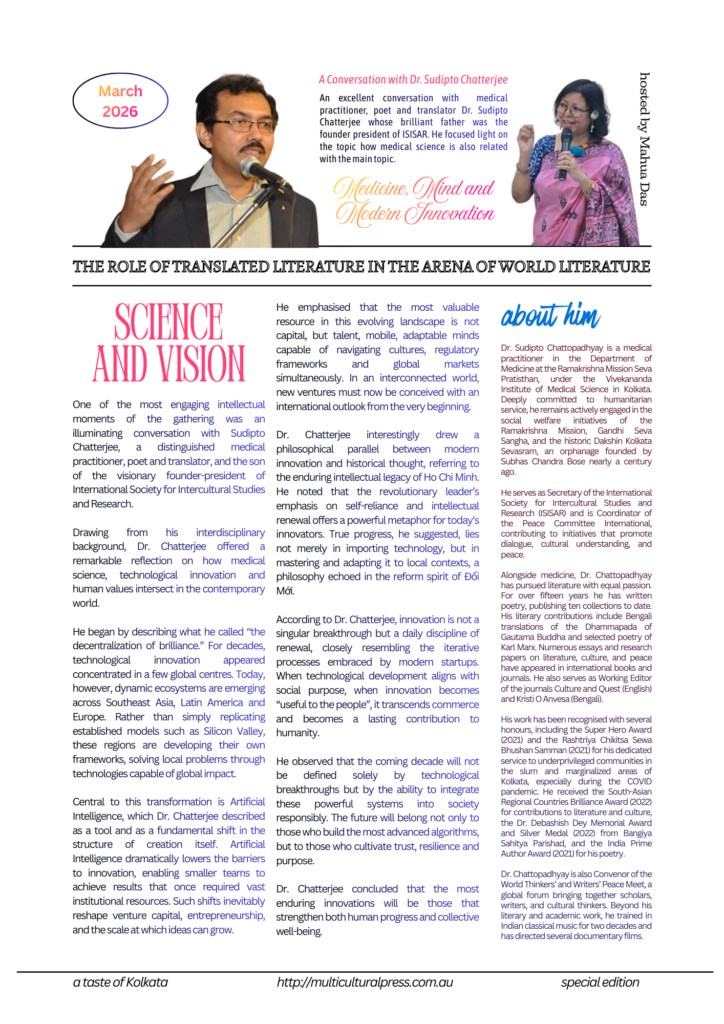
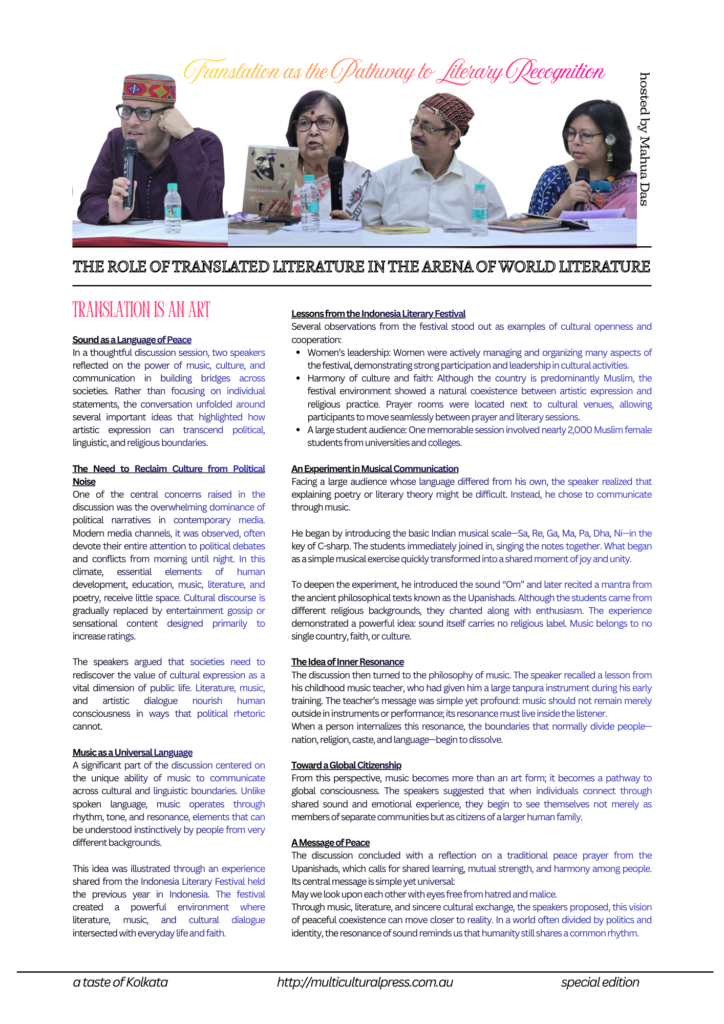
A central feature of the session was the discussion titled “The Role of Translated Literature in the Arena of World Literature.” The dialogue brought together distinguished speakers who reflected upon the importance of translation as a bridge between cultures. Among them was the eminent poet Priti Sanyal, honoured with the Palmes Académiques by the French Government and formerly associated with India House in Paris. At eighty-eight years of age, she addressed the audience with grace and authority, sharing insights drawn from decades of literary and cultural engagement. Her reflections illuminated the responsibility and artistry involved in translation.
Poet and novelist Binayak Bandyopadhyay contributed thoughtful observations on literary interpretation and the creative dimension of translation. Another significant voice in the discussion came from Sudipto Chatterjee, medical practitioner, poet, translator, and current president of ISISAR. His remarks connected the realms of medical science and literature through reflections on empathy, understanding, and human experience. The final speaker in the panel, the respected poet and organiser Pinaki Roy, offered perspectives on literary collaboration and the role of institutions in sustaining cultural dialogue.
Mahua Das guided the discussion with clarity and sensitivity, ensuring a lively exchange of ideas. At several moments she recited poems connected to the speakers, creating a seamless flow between dialogue and artistic expression. The discussion concluded with a gentle chant led by Dr. Sudipto Chatterjee, adding a contemplative cadence to the gathering.
The session then welcomed international poets who had travelled to India for the festival. Their readings created a vivid moment of global literary sharing. Among the poets were Alexandra Nicod from Switzerland, Võ Thị Như Mai from Vietnam and Australia, Muniam Alfaker from Denmark, along with Hong Hanh and Duy Pham from Vietnam. Their poems carried images of landscapes, memory, and cultural heritage. Listeners responded with warm applause and deep appreciation. Mahua Das presented a Bengali recitation of Alexandra Nicod’s poem, offering the audience another glimpse of translation as creative dialogue between languages.
As the session approached its conclusion, singer Priyankar Majumdar performed a cheerful closing song that filled the hall with a sense of celebration and shared joy. The programme was gracefully hosted by Mahua Das together with Somdatta Chatterjee, whose presence ensured smooth coordination throughout the event.
The evening continued with the literary session titled “Gahan,” coordinated by Mostak Ahamed, bringing together Indian and international participants in reflective conversation. The title suggested depth and introspection, qualities that resonated strongly during the closing hours of the festival. Writers, poets, and scholars shared thoughts, memories, and hopes for future collaborations.
The final day of the Thinkers’ and Writers’ Peace Meet and International Book Festival carried a spirit of fulfilment and cultural harmony. Across the halls of Rotary Sadan, voices from many regions and traditions created a collective narrative shaped by poetry, discussion, and music. The gathering offered a vivid reminder of literature’s enduring ability to connect people through language, imagination, and shared human experience.
+++++