
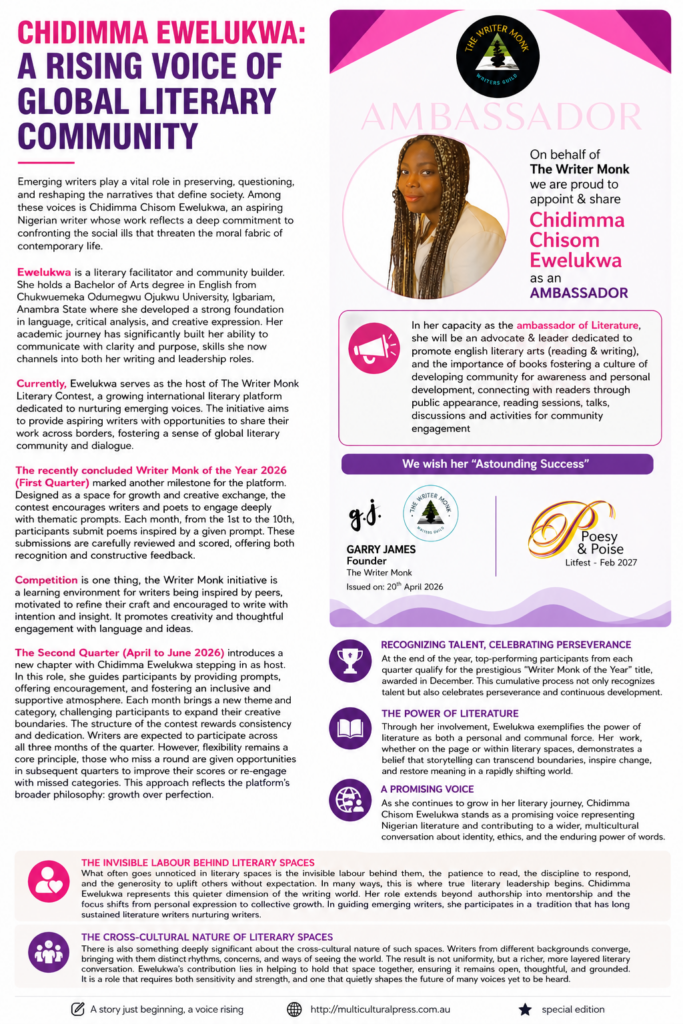
Emerging writers play a vital role in preserving, questioning, and reshaping the narratives that define society. Among these voices is Chidimma Chisom Ewelukwa, an aspiring Nigerian writer whose work reflects a deep commitment to confronting the social ills that threaten the moral fabric of contemporary life.
Ewelukwa is a literary facilitator and community builder. She holds a Bachelor of Arts degree in English from Chukwuemeka Odumegwu Ojukwu University, Igbariam, Anambra State where she developed a strong foundation in language, critical analysis, and creative expression. Her academic journey has significantly built her ability to communicate with clarity and purpose, skills she now channels into both her writing and leadership roles.
Currently Ewelukwa serves as the host of The Writer Monk Literary Contest, a growing international literary platform dedicated to nurturing emerging voices. The initiative aims to provide aspiring writers with opportunities to share their work across borders, fostering a sense of global literary community and dialogue.
The recently concluded Writer Monk of the Year 2026 (First Quarter) marked another milestone for the platform. Designed as a space for growth and creative exchange, the contest encourages writers and poets to engage deeply with thematic prompts. Each month, from the 1st to the 10th, participants submit poems inspired by a given prompt. These submissions are carefully reviewed and scored, offering both recognition and constructive feedback.
Competition is one thing, the Writer Monk initiative is a learning environment for writers being inspired by peers, motivated to refine their craft and encouraged to write with intention and insight. It promotes creativity and thoughtful engagement with language and ideas.
The Second Quarter (April to June 2026) introduces a new chapter with Chidimma Ewelukwa stepping in as host. In this role, she guides participants by providing prompts, offering encouragement, and fostering an inclusive and supportive atmosphere. Each month brings a new theme and category, challenging participants to expand their creative boundaries.
The structure of the contest rewards consistency and dedication. Writers are expected to participate across all three months of the quarter. However, flexibility remains a core principle, those who miss a round are given opportunities in subsequent quarters to improve their scores or re-engage with missed categories. This approach reflects the platform’s broader philosophy: growth over perfection.
At the end of the year, top-performing participants from each quarter qualify for the prestigious “Writer Monk of the Year” title, awarded in December. This cumulative process not only recognizes talent but also celebrates perseverance and continuous development.
Through her involvement, Ewelukwa exemplifies the power of literature as both a personal and communal force. Her work, whether on the page or within literary spaces, demonstrates a belief that storytelling can transcend boundaries, inspire change, and restore meaning in a rapidly shifting world.
As she continues to grow in her literary journey, Chidimma Chisom Ewelukwa stands as a promising voice representing Nigerian literature and contributing to a wider, multicultural conversation about identity, ethics, and the enduring power of words.
What often goes unnoticed in literary spaces is the invisible labour behind them, the patience to read, the discipline to respond, and the generosity to uplift others without expectation. In many ways, this is where true literary leadership begins. Chidimma Ewelukwa represents this quieter dimension of the writing world. Her role extends beyond authorship into mentorship and the focus shifts from personal expression to collective growth. In guiding emerging writers, she participates in a tradition that has long sustained literature: writers nurturing writers.
There is also something deeply significant about the cross-cultural nature of such spaces. Writers from different backgrounds converge, bringing with them distinct rhythms, concerns, and ways of seeing the world. The result is not uniformity, but a richer, more layered literary conversation. Ewelukwa’s contribution lies in helping to hold that space together, ensuring it remains open, thoughtful, and grounded. It is a role that requires both sensitivity and strength, and one that quietly shapes the future of many voices yet to be heard.
Literature is built by communities that choose to listen, respond, and grow together. It is within such spaces that writing finds not only its audience, but its purpose.

Congratulations