One of the defining strengths of the 36th Medellín International Poetry Festival is its commitment to bringing together established poets and emerging voices from around the world. The festival also creates an important space for Indigenous poets to share their cultures, languages, and traditions alongside contemporary international literature, enriching the dialogue through diverse perspectives.
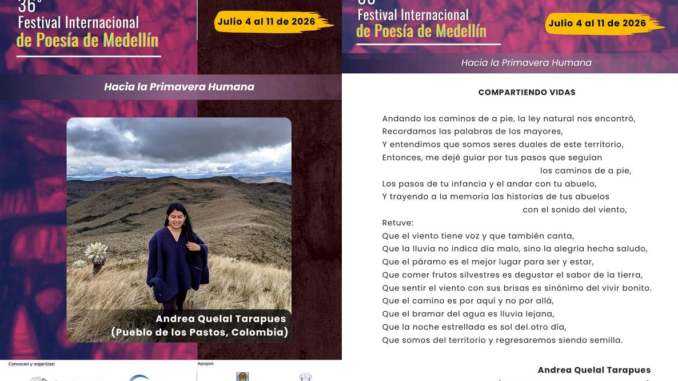
Among these inspiring participants is Andrea Quelal Tarapuez, a young Indigenous poet from the Pastos people of the Gran Cumbal Indigenous Reservation in Nariño, southern Colombia. During the festival, I had the pleasure of speaking with Andrea about her experience as one of this year’s invited young poets, the inspiration behind her writing, and the message she hopes to share with readers both in Colombia and around the world.
For Andrea, poetry begins with the territory itself. She describes her homeland as a living source of knowledge that invites people to walk the land, read it, understand it, and learn from it. Her poems emerge from this dialogue with nature, memory, and ancestral wisdom, reflecting the worldview of her people and their enduring relationship with the land.
Andrea also speaks passionately about the role of poetry in preserving Indigenous languages. As part of an ongoing process of language revitalization within her community, she believes poetry helps carry forward voices that have endured for generations. She rejects the common misconception that Indigenous languages are disappearing, emphasizing instead that Indigenous peoples and their languages remain alive and continue to flourish through the commitment of younger generations.
Participating in the Medellín International Poetry Festival has been both an honour and a responsibility for Andrea. She sees the festival as an opportunity not only to share the voice of her community with an international audience, but also to learn from poets from many different cultures. For her, poetry creates a space where dialogue, mutual understanding, and cultural exchange can thrive beyond geographical and linguistic boundaries.
Throughout our conversation, Andrea reminds us that poetry is also an act of resistance, one that safeguards memory, strengthens cultural identity, and connects the wisdom of ancestors with the voices of today’s youth. Her work reflects a deep respect for the territory, oral tradition, and the living heritage of the Pastos people.
We invite you to read the full interview and discover the thoughtful voice of Andrea Quelal Tarapuez, a young Indigenous poet whose work celebrates the resilience of her people, the beauty of ancestral knowledge, and the enduring power of language and poetry.
Interviewer: Hi, Andrea. It’s nice to meet you today. Can you tell us a bit about yourself?
Andrea: Thank you. Hello, my name is Andrea Quelal Tarapuez. I am an Indigenous woman from the Pastos people, belonging to the Gran Cumbal Indigenous Reservation in the department of Nariño, Colombia. Thank you for the invitation.
Interviewer: As a young poet selected to participate in the 36th International Medellín Poetry Festival, how do you feel?
Andrea: I feel very happy, very excited, and deeply grateful. I also feel that it is a great responsibility because, as Indigenous peoples, we bring voices of resistance—a resistance that has existed for thousands of years. Our grandparents and Elders have taught us that it is important to be part of spaces like these. Being at an international festival allows me to share my voice while also learning from many other voices from around the world.
Interviewer: What inspired you to write, and what do you usually write about?
Andrea: My greatest inspiration is the territory itself. We have been nurturing dialogues that invite us to walk the land. Our poetry goes beyond the material world. We believe it is important to walk the territory, to learn how to read it, understand it, and interpret its meanings. Through our poetry, we also carry the resistance of our ancestral peoples and our determination to continue existing through our Indigenous languages.
We have been working on a process of language revitalization that is deeply meaningful to us. We want the world to encounter our poetry and these voices of resistance, rather than believing the false idea that Indigenous languages are dead. That is simply not true. Indigenous languages and Indigenous peoples are alive. We continue to exist and endure through space and time. This festival is therefore an incredibly valuable opportunity—not only to share our poetry with the world, but also to show the language revitalization processes we are carrying out and how poetry contributes to those efforts.
Interviewer: As a young poet from Colombia, what message would you like to share with other young poets in Colombia and around the world?
Andrea: I believe the most important message is to share the wisdom that is embedded in the territory itself. In many ways, the Western world has forgotten how to dialogue with the land—to read it, understand it, and interpret it. My poems reflect these conversations with the voices of the grandmother stones, which live on through oral tradition and safeguard the memory and writing of our own language and Indigenous tongue.
I also want to tell people that there are no dead languages in Colombia or anywhere else in the world. We are peoples who continue to live and exist. There are language revitalization processes that remind us these are not dead languages—they are sleeping languages that need to be awakened. And it is we, the younger generations, who have answered that call, that voice coming from the territory itself.
Interviewer: Through our conversation, it also proves that language has no borders. We can communicate in different ways. Thank you so much, and I hope we can stay in touch again in the future.
Andrea: Thank you. Gracias.