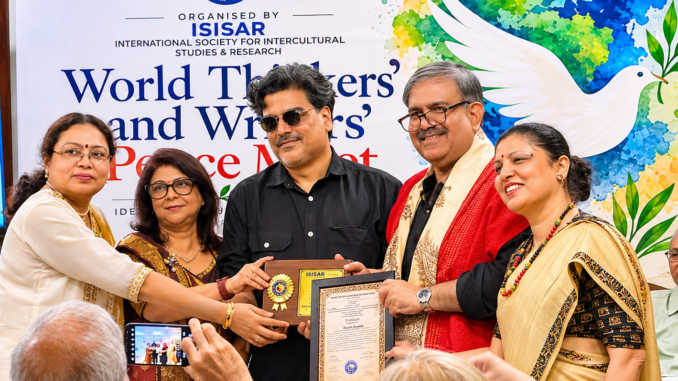
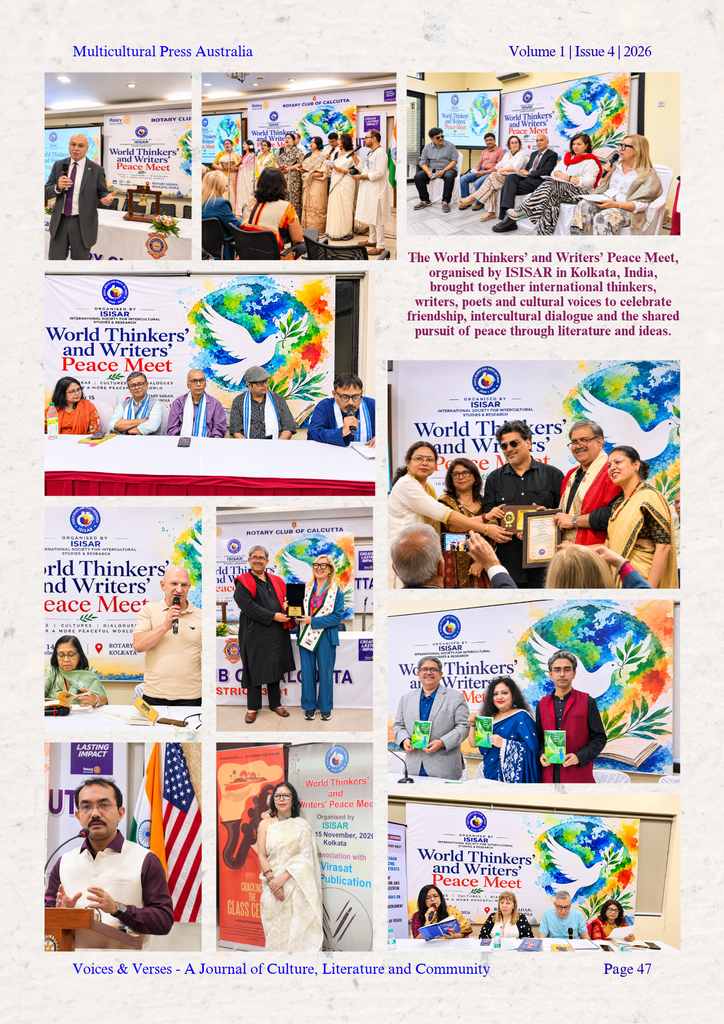
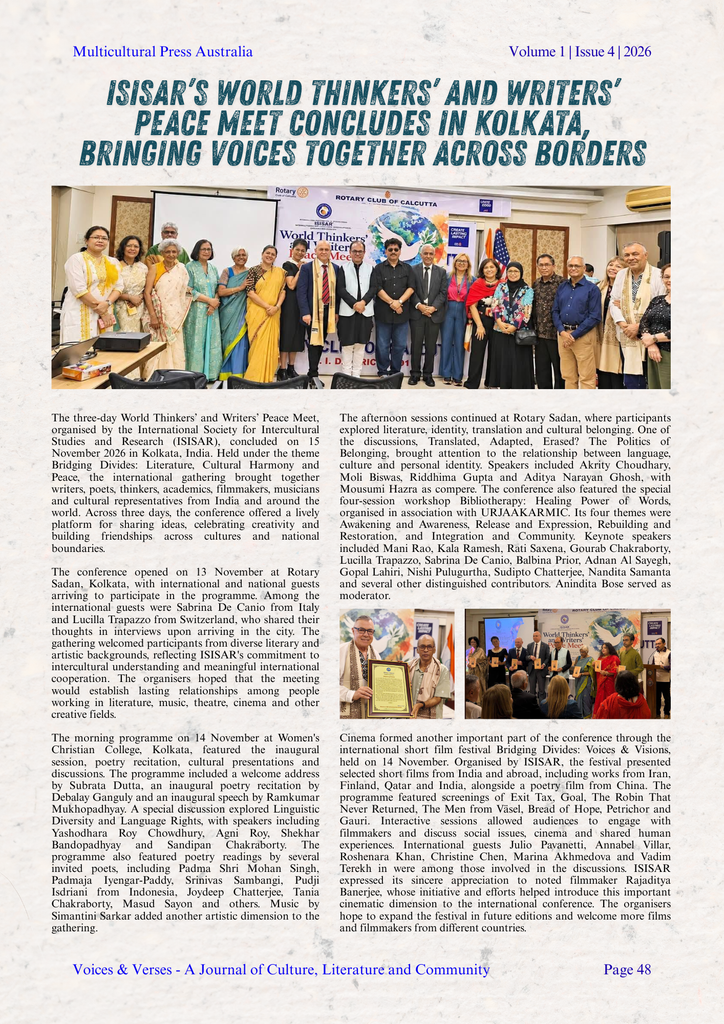
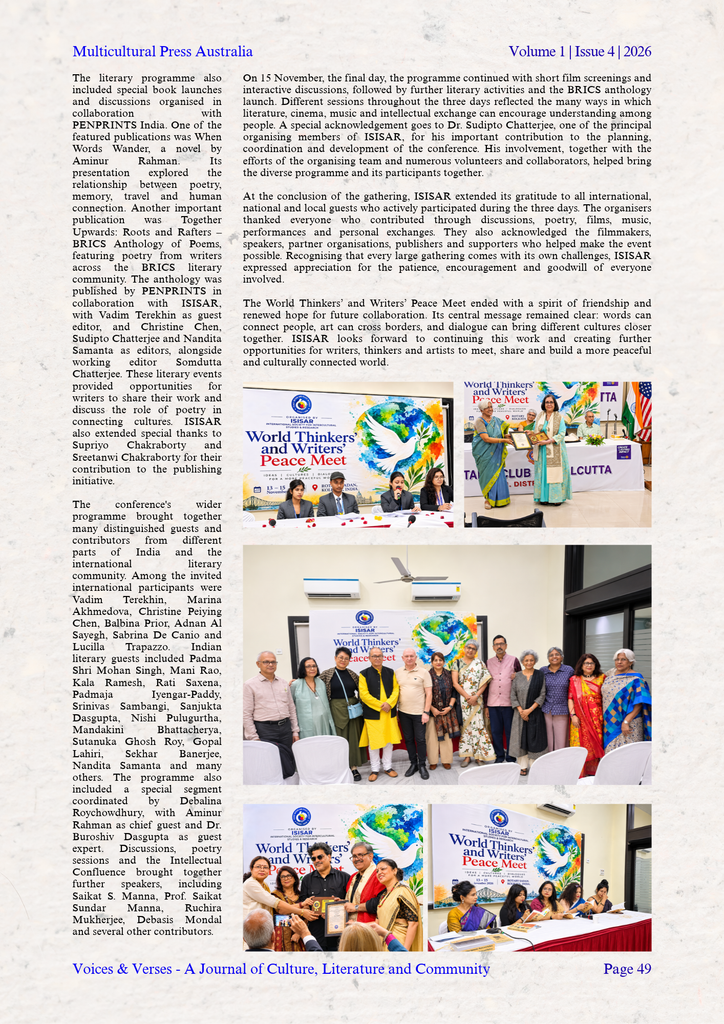
The three-day World Thinkers’ and Writers’ Peace Meet, organised by the International Society for Intercultural Studies and Research (ISISAR), concluded on 15 November 2026 in Kolkata, India. Held under the theme Bridging Divides: Literature, Cultural Harmony and Peace, the international gathering brought together writers, poets, thinkers, academics, filmmakers, musicians and cultural representatives from India and around the world. Across three days, the conference offered a lively platform for sharing ideas, celebrating creativity and building friendships across cultures and national boundaries.
The conference opened on 13 November at Rotary Sadan, Kolkata, with international and national guests arriving to participate in the programme. Among the international guests were Sabrina De Canio from Italy and Lucilla Trapazzo from Switzerland, who shared their thoughts in interviews upon arriving in the city. The gathering welcomed participants from diverse literary and artistic backgrounds, reflecting ISISAR’s commitment to intercultural understanding and meaningful international cooperation. The organisers hoped that the meeting would establish lasting relationships among people working in literature, music, theatre, cinema and other creative fields.
The morning programme on 14 November at Women’s Christian College, Kolkata, featured the inaugural session, poetry recitation, cultural presentations and discussions. The programme included a welcome address by Subrata Dutta, an inaugural poetry recitation by Debalay Ganguly and an inaugural speech by Ramkumar Mukhopadhyay. A special discussion explored Linguistic Diversity and Language Rights, with speakers including Yashodhara Roy Chowdhury, Agni Roy, Shekhar Bandopadhyay and Sandipan Chakraborty. The programme also featured poetry readings by several invited poets, including Padma Shri Mohan Singh, Padmaja Iyengar-Paddy, Srinivas Sambangi, Pudji Isdriani from Indonesia, Joydeep Chatterjee, Tania Chakraborty, Masud Sayon and others. Music by Simantini Sarkar added another artistic dimension to the gathering.
The afternoon sessions continued at Rotary Sadan, where participants explored literature, identity, translation and cultural belonging. One of the discussions, Translated, Adapted, Erased? The Politics of Belonging, brought attention to the relationship between language, culture and personal identity. Speakers included Akrity Choudhary, Moli Biswas, Riddhima Gupta and Aditya Narayan Ghosh, with Mousumi Hazra as compere. The conference also featured the special four-session workshop Bibliotherapy: Healing Power of Words, organised in association with URJAAKARMIC. Its four themes were Awakening and Awareness, Release and Expression, Rebuilding and Restoration, and Integration and Community. Keynote speakers included Mani Rao, Kala Ramesh, Rati Saxena, Gourab Chakraborty, Lucilla Trapazzo, Sabrina De Canio, Balbina Prior, Adnan Al Sayegh, Gopal Lahiri, Nishi Pulugurtha, Sudipto Chatterjee, Nandita Samanta and several other distinguished contributors. Anindita Bose served as moderator.
Cinema formed another important part of the conference through the international short film festival Bridging Divides: Voices & Visions, held on 14 November. Organised by ISISAR, the festival presented selected short films from India and abroad, including works from Iran, Finland, Qatar and India, alongside a poetry film from China. The programme featured screenings of Exit Tax, Goal, The Robin That Never Returned, The Men from Väsel, Bread of Hope, Petrichor and Gauri. Interactive sessions allowed audiences to engage with filmmakers and discuss social issues, cinema and shared human experiences. International guests Julio Pavanetti, Annabel Villar, Roshenara Khan, Christine Chen, Marina Akhmedova and Vadim Terekh in were among those involved in the discussions. ISISAR expressed its sincere appreciation to noted filmmaker Rajaditya Banerjee, whose initiative and efforts helped introduce this important cinematic dimension to the international conference. The organisers hope to expand the festival in future editions and welcome more films and filmmakers from different countries.
The literary programme also included special book launches and discussions organised in collaboration with PENPRINTS India. One of the featured publications was When Words Wander, a novel by Aminur Rahman. Its presentation explored the relationship between poetry, memory, travel and human connection. Another important publication was Together Upwards: Roots and Rafters – BRICS Anthology of Poems, featuring poetry from writers across the BRICS literary community. The anthology was published by PENPRINTS in collaboration with ISISAR, with Vadim Terekhin as guest editor, and Christine Chen, Sudipto Chatterjee and Nandita Samanta as editors, alongside working editor Somdutta Chatterjee. These literary events provided opportunities for writers to share their work and discuss the role of poetry in connecting cultures. ISISAR also extended special thanks to Supriyo Chakraborty and Sreetanwi Chakraborty for their contribution to the publishing initiative.
The conference’s wider programme brought together many distinguished guests and contributors from different parts of India and the international literary community. Among the invited international participants were Vadim Terekhin, Marina Akhmedova, Christine Peiying Chen, Balbina Prior, Adnan Al Sayegh, Sabrina De Canio and Lucilla Trapazzo. Indian literary guests included Padma Shri Mohan Singh, Mani Rao, Kala Ramesh, Rati Saxena, Padmaja Iyengar-Paddy, Srinivas Sambangi, Sanjukta Dasgupta, Nishi Pulugurtha, Mandakini Bhattacherya, Sutanuka Ghosh Roy, Gopal Lahiri, Sekhar Banerjee, Nandita Samanta and many others. The programme also included a special segment coordinated by Debalina Roychowdhury, with Aminur Rahman as chief guest and Dr. Buroshiv Dasgupta as guest expert. Discussions, poetry sessions and the Intellectual Confluence brought together further speakers, including Saikat S. Manna, Prof. Saikat Sundar Manna, Ruchira Mukherjee, Debasis Mondal and several other contributors.
On 15 November, the final day, the programme continued with short film screenings and interactive discussions, followed by further literary activities and the BRICS anthology launch. Different sessions throughout the three days reflected the many ways in which literature, cinema, music and intellectual exchange can encourage understanding among people. A special acknowledgement goes to Dr. Sudipto Chatterjee, one of the principal organising members of ISISAR, for his important contribution to the planning, coordination and development of the conference. His involvement, together with the efforts of the organising team and numerous volunteers and collaborators, helped bring the diverse programme and its participants together.
At the conclusion of the gathering, ISISAR extended its gratitude to all international, national and local guests who actively participated during the three days. The organisers thanked everyone who contributed through discussions, poetry, films, music, performances and personal exchanges. They also acknowledged the filmmakers, speakers, partner organisations, publishers and supporters who helped make the event possible. Recognising that every large gathering comes with its own challenges, ISISAR expressed appreciation for the patience, encouragement and goodwill of everyone involved.
The World Thinkers’ and Writers’ Peace Meet ended with a spirit of friendship and renewed hope for future collaboration. Its central message remained clear: words can connect people, art can cross borders, and dialogue can bring different cultures closer together. ISISAR looks forward to continuing this work and creating further opportunities for writers, thinkers and artists to meet, share and build a more peaceful and culturally connected world.
Leave a Reply