Perth Poetry Festival 2026 · Ear to the Ground – AI can produce a sonnet in seconds. But is it a poem?
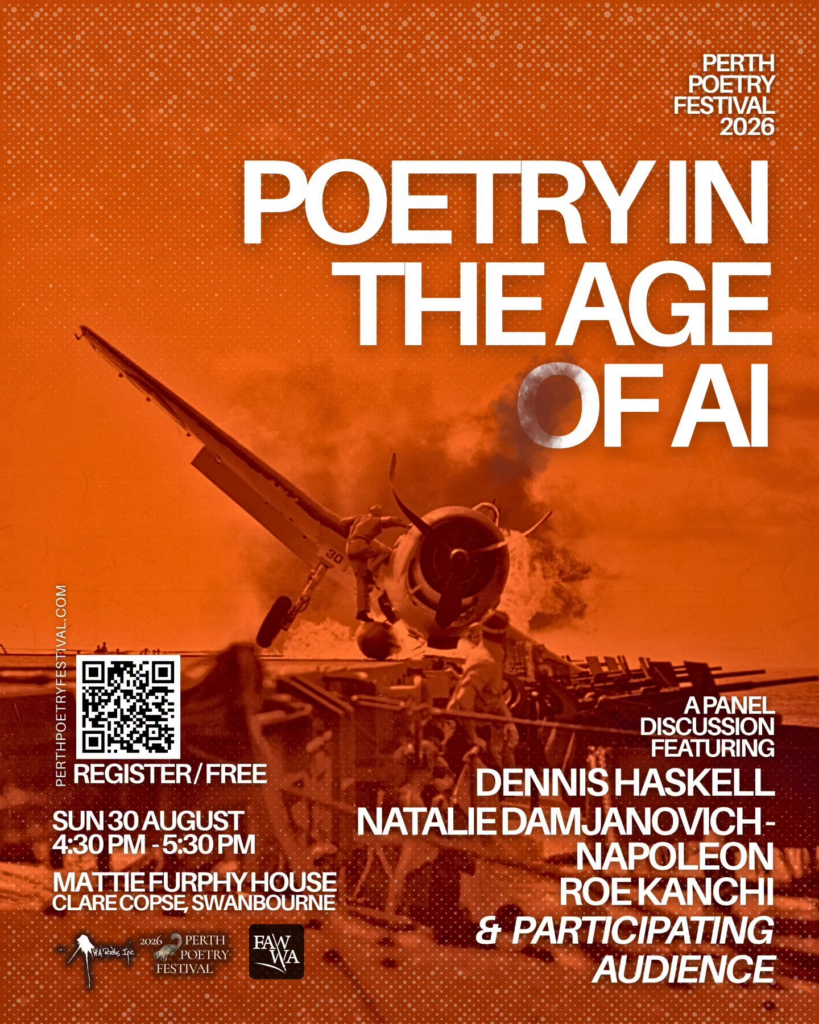
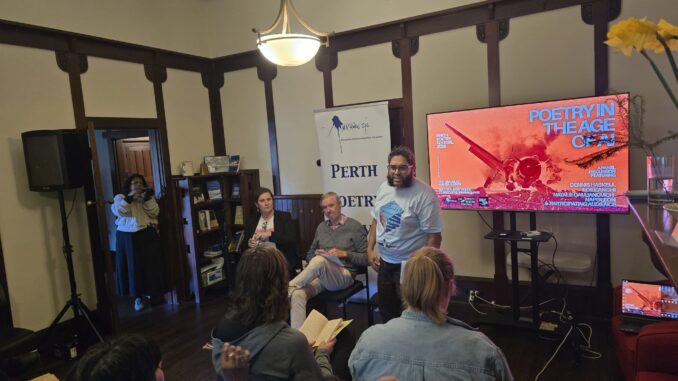
It is a deceptively simple question, but on Sunday 30 August, at Perth Poetry Festival 2026, it opened a much larger and more unsettling conversation. During the panel discussion “Poetry in the Age of AI: Can a Machine Write a Poem?”, poets, educators, technologists and an unusually engaged audience gathered to consider what artificial intelligence might mean for one of humanity’s oldest creative practices. The panel brought together Dennis Haskell AM, poet and Emeritus Professor at The University of Western Australia; Natalie Damjanovich-Napoleon, writer, songwriter and educator; and Roe Kanchi, poet, IT consultant and Web Officer at WA Poets Inc, whose work sits at an intersection between technology and poetry. What began as a question about whether a machine can generate a poem quickly became a discussion about consciousness, authorship, originality, copyright, education, artistic labour, corporate power, memory, political freedom and the nature of human experience. The most difficult question was not whether a computer could arrange words into lines, produce metaphors or imitate the conventions of a sonnet. It was whether something produced by a machine could ever carry what human beings bring to poetry: a life lived, a body experienced, a memory accumulated, a wound survived, a love felt, a history inherited and a consciousness attempting to make sense of it all.
.
Can a Machine Create?
Dennis Haskell opened the conversation from a position that was neither fearful nor dismissive. He described himself as naturally optimistic about artificial intelligence and its potential to accomplish things that would otherwise be difficult or impossible, while also recognising the anxiety surrounding its rapid development. For Haskell, the attraction of AI is inseparable from a much older human fascination: what exactly happens inside a mind when it thinks, imagines and creates? If a machine can produce something that looks creative, does that tell us something about the machine, or does it tell us something about our own definition of creativity? To move the question beyond theory, Haskell had asked Claude to write a poem. The resulting piece was recognisably poetic, containing images of rivers, stones, movement and reflection. It was sufficiently convincing to make the room pause. If the words sound poetic, what exactly are we objecting to when we say they are not poetry?
Almost immediately, however, the audience pushed the discussion into more difficult territory. One audience member wondered how anyone could know whether an AI-generated poem had drawn from existing poetry. The question shifted the conversation from aesthetics to ethics. Large language models are trained on vast quantities of human-created material, and the implications of that process for authorship and ownership remain deeply contested. A machine may produce a new combination of words, but those words emerge from a system built through exposure to an enormous cultural archive created by human beings. At the same time, Haskell acknowledged an uncomfortable parallel: human poets also write from what came before. Writers read other writers. They absorb rhythms, forms, images, arguments and traditions. Every poet enters a literary history already in progress. No writer begins in an empty room. The difficult distinction, therefore, is not simply between “original” human writing and “copied” machine writing. It lies in the nature of influence, transformation, imitation and creation, and in whether the entity doing the transforming possesses any intention or experience of its own.
Haskell introduced another example that complicated the assumption that machines can only reproduce what humans have already done: the famous 2016 Go match between AlphaGo and South Korean champion Lee Sedol. During the contest, AlphaGo made a move that was so unexpected that it challenged established ideas about how the game could be played. The move appeared strange precisely because it did not follow the patterns human players had traditionally relied upon. If a machine can discover a move that surprises the people who created the game and taught the machine how to play it, perhaps we should be cautious about claiming that machines can only reproduce human ideas. They may generate combinations that no individual human has previously considered.
But the panel was equally cautious about equating novelty with creativity. Natalie Damjanovich-Napoleon drew an important distinction between computational problem-solving and artistic creation. A machine can calculate possibilities at a scale no human mind can approach. It can identify patterns, compare enormous quantities of information, test variations and arrive at solutions with extraordinary speed. In games, science, medicine and many other fields, this capacity may prove enormously valuable. But poetry asks a different kind of question. It is not simply a problem waiting to be solved. Poetry asks what human beings are trying to communicate about existence. It asks what it means to lose someone, to desire someone, to remember a place, to grow older, to experience injustice, to belong to a culture, to be displaced from one, to love, to grieve, to hope or to fear. A machine may be able to identify the linguistic patterns associated with these experiences. The question is whether identifying those patterns is equivalent to having the experience itself.
.
The Human Body Behind the Poem
Damjanovich-Napoleon approached the question through something wonderfully ordinary: the T-shirt she was wearing. It had been designed and printed by singer-songwriter Laura Veirs, and people regularly commented on it. What mattered to Damjanovich-Napoleon was not merely the design itself but the fact that it was human-made and handmade. The T-shirt became a small, tangible example of a much larger idea: that part of the value of creative work lies in knowing that another human being made it.
Her own relationship with writing has been lifelong. She began writing at ten, became a singer-songwriter at twenty and continued writing poetry alongside her musical work. She has worked in writing centres, taught students how to write, taught EAL students academic writing, judged poetry competitions and read thousands of poems. From that accumulated experience, she sees writing not as a button that produces a finished object but as a process. Writers brainstorm. They make plans. They draft badly. They edit. They cut things they thought were wonderful. They rewrite. They read their work aloud and discover that something which looked fine on a screen does not work when spoken. They share their writing with other people. They receive feedback. They discover meanings they did not consciously intend. They return to the beginning and start again.
That process, she argued, is not simply an inefficient route to a finished poem. It is part of what writing does to a human being. Writing changes the writer. One of the most powerful ideas to emerge from her contribution was that we do not always write because we already know what we think. Sometimes we write in order to discover what we think. She described the experience of beginning an essay convinced of one position, only to research, draft, revise and receive feedback before discovering that her understanding had changed. The writing had not merely communicated a pre-existing thought; it had produced a new one.
This becomes particularly important in an age when AI can generate a polished response almost instantly. If a student or writer asks a machine to produce the finished argument before they have wrestled with the question themselves, they may receive an efficient answer while losing the intellectual journey that would have allowed them to develop their own position. The danger is not simply that AI might make people lazy. It is that it might deprive people of the productive struggle through which judgement, voice and understanding develop.
The same argument applies to poetry. A poem may appear effortless, but apparent effortlessness can be the result of years of effort. A poet may write a line in ten seconds because they have spent fifteen years becoming the kind of writer capable of recognising that particular line when it arrives. The ease of the final poem can conceal an enormous history of reading, failed poems, experiments, conversations, revisions, listening and attention. AI can reproduce the appearance of that finished product. What it cannot automatically reproduce is the human history that made the poet capable of creating it.
For Damjanovich-Napoleon, embodiment is central to the distinction. She does not believe that AI is conscious in the human sense. A large language model has no body, no childhood, no family, no lover, no personal history and no lived experience. It has never had its heart broken. It has never experienced the physical and emotional reality of grief. It has never stood beside a hospital bed, buried someone it loved, watched a child grow up, migrated across a border or carried memories of a particular landscape throughout a lifetime. It can generate extraordinarily convincing language about such things because it has encountered enormous quantities of human language describing them. But reproducing the language of grief is not necessarily the same thing as grieving.
That distinction became one of the emotional centres of the discussion. An AI can write about love, but has it ever loved? It can write about loss, but has it ever lost? It can write about loneliness, but has it ever been alone? It can write about trauma, but has it ever had to survive one? The panel was not claiming that every human poem is automatically profound or that every AI poem is automatically empty. Rather, it was asking us to consider why particular poems matter to us in the first place. Often, the answer is that we recognise another human consciousness behind them. We recognise someone who has lived something, noticed something, remembered something and made the decision to transform that experience into language.
.
The Knowledge Behind the Machine
Roe Kanchi brought a different perspective to the discussion, informed by his experience moving between technology and poetry. His position was notably pragmatic. He did not argue that AI should simply be rejected. Instead, he asked the audience to distinguish between the different ways the technology can be used. Some tasks surrounding poetry are administrative rather than creative. Kanchi’s volunteer work includes promoting poetry events and communicating through social media, and creating routine social-media material is not necessarily the part of the work he most values. For these purposes, he can use ChatGPT as a practical tool. The important distinction is that he is not asking the machine to replace his poetry. He is using it to assist with the infrastructure surrounding poetry.
That distinction suggests a more useful question than “AI or no AI?” Perhaps the question should be: What are we asking AI to do, and what are we unwilling to give away? There is a meaningful difference between using artificial intelligence to help format an event announcement and asking it to write the poem that is supposed to express a person’s deepest experience. There is also a difference between using AI to brainstorm possibilities and allowing it to make every significant creative decision. The ethical question is therefore not simply whether AI has entered the creative process, but whether the human being remains genuinely responsible for that process.
Kanchi also challenged the increasingly simplistic stigma surrounding AI use. He asked the audience how many people had experimented with AI. Almost every hand in the room went up. He then asked how many used it regularly, and again a substantial number of hands remained raised. The response was significant. AI is no longer a distant technology that society can debate as though it exists somewhere outside ordinary life. It is already woven into phones, computers, browsers, search engines, workplaces and educational environments. The question of whether we will encounter AI has largely been settled. The question now is what kind of relationship we will have with it.
Kanchi drew a comparison with social media and its algorithms. He described being surprised by the political material repeatedly appearing in the Instagram feed of his nineteen-year-old nephew. The experience illustrated a broader problem: technologies can influence people not only through the content they create but through the systems that determine what information becomes visible. For Kanchi, this means society should be careful about directing all its anger towards “AI” as though the technology itself were an independent actor. Behind these systems are corporations, investors, programmers, platforms and commercial interests making decisions about how technology is developed, deployed and monetised. The public conversation therefore needs to look beyond the machine and ask who owns it, who controls it, who profits from it and whose work was used to build it.
This returned the discussion to copyright, one of the most immediate concerns for poets and other artists. Large language models depend upon enormous bodies of human-created knowledge: books, poems, journalism, research, music, images and countless other forms of cultural labour. That material did not appear from nowhere. People spent years and decades creating it. Artists struggled to develop their voices. Writers were paid, or sometimes not paid, for their work. Communities built cultural traditions. Researchers accumulated knowledge. Musicians created recordings. Poets published poems. The economic question is therefore unavoidable: who benefits when all of this human-created material becomes raw material for commercial AI systems?
Damjanovich-Napoleon argued that artists should not simply have their work absorbed into commercial systems without serious consideration of ownership and compensation. The question is larger than whether a particular AI-generated poem can be traced to a particular existing poem. It is about the economic relationship between human creative labour and the companies building systems capable of reproducing its patterns at scale. If the value of human culture becomes the foundation of powerful commercial technologies, society must ask how that value is distributed and whether creators have meaningful rights over the use of their work.
.
The Shortcut and the Crisis in Education
For Kanchi, one of the greatest dangers AI presents to poetry is not that machines will eliminate poets but that they may eliminate the work of becoming a poet. The technology offers an extraordinary shortcut. It can produce something that looks finished before the writer has undertaken the years of learning required to develop judgement and voice.
He offered an illuminating example: a poet whose work appeared to have been written almost effortlessly on a tram. The poem may have taken only minutes to put onto the page, but the poet explained that it had taken fifteen years to become capable of writing something that could appear so effortless. That observation cuts to the heart of the AI debate. The finished poem is not the whole story. Behind it are fifteen years of reading, writing, listening, failing, experimenting and learning how language behaves.
This issue becomes particularly serious in education. The panel discussed the growing difficulty educators face when students can use AI to generate assignments, essays and examination answers. One example involved a university examination in which a student’s computer was reportedly being used remotely to generate answers while the student was sitting the exam. Such situations place teachers in an almost impossible position. How can an educator assess what a student knows if the student’s apparent work may have been produced by a machine?
Some universities have responded by returning to handwritten assessments and other forms of supervised work. But the underlying problem is not simply cheating. It is the educational value of writing itself. When a student struggles through an essay, they are not merely manufacturing a product for a teacher. They are learning to organise information, make judgements, construct arguments, identify contradictions, revise their assumptions and discover what they actually believe. The struggle is part of the education. An AI-generated essay may be grammatically superior and structurally polished while simultaneously representing a failure to learn the very skills the assignment was designed to develop.
The same concern applies to poetry education. Kanchi recalled teaching a poetry class at ECU before generative AI had become so dominant. He remembered students producing work of extraordinary emotional power. Some poems moved him to tears. The memory raised a difficult challenge: could an AI-generated poem do the same?
Of course, a machine can reproduce the linguistic signals associated with emotional poetry. It can produce a poem about grief, carefully selecting images and rhythms likely to affect a reader. But the panel’s question was more fundamental. What happens when the person behind the poem is absent? What happens when the language of an experience exists without the experience itself?
.
Poetry Is More Than That
Again and again, the conversation returned to the difference between product and process. A poem is certainly an object made from words, but it is also the trace of an activity. It records attention. It records selection. It records the writer deciding that one word belongs and another does not. It contains memories, associations, cultural references, sounds and silences. Sometimes it records an experience the writer has spent years trying to understand.
When a poet writes about grief, the poem may contain the particular details of someone who is no longer alive. When a poet writes about migration, the language may carry the memory of leaving one place and arriving in another. When a poet writes about injustice, the poem may emerge from witnessing. When a poet writes about love, the poem may have been shaped by an actual relationship. Poetry becomes a meeting point between language and life.
That is why the panel resisted the idea that poetry should be understood merely as a product that can be generated more efficiently. The value of a poem may reside partly in the process through which a human being makes meaning.
The wider Perth Poetry Festival provided a particularly powerful setting for this discussion. Throughout the festival, poetry appeared in many forms: visual poetry, song, spoken word, slam, collage, found words and workshops exploring the possibilities of language. Poetry was not presented as a single fixed genre with one definition. It was a rainbow of forms, constantly stretching and reinventing itself. Yet beneath those different forms was a shared conviction that words matter.
Damjanovich-Napoleon asked the audience to consider why authoritarian and fascist regimes so often imprison poets and writers. The answer was implicit in the question itself: words have power. Poetry can challenge authority, preserve memory, expose injustice and speak for people who have been silenced. Poets listen to rivers, trees and wind. They write about racism, grief, environmental destruction, sexism, homophobia, antisemitism, Islamophobia and ableism. They challenge complacency. They ask audiences to imagine something better and, sometimes, to build it.
In that context, poetry is more than personal expression. It can be an act of resistance.
.
The Empty Chair and the Power of Witness
The festival’s commitment to poetry as witness was also reflected in an “empty chair” dedicated to Ahmed Douma, the Egyptian poet, writer and activist. Damjanovich-Napoleon spoke about his continuing difficulties with Egyptian authorities, including his detention and prosecution in connection with allegations concerning social-media posts about his experiences in prison. His absence became a physical reminder of writers who cannot freely sit among their fellow poets.
The symbolism of the empty chair was particularly powerful in a festival centred on listening. An empty chair is not simply an absence. It can represent a voice that has been prevented from being heard. It can represent the writer who is imprisoned, threatened, censored or forced into silence. It can also represent the responsibility of those who are free to speak about those who are not.
The discussion connected with the work of PEN and its advocacy for writers around the world who face imprisonment, threats and harassment. In this setting, the question of AI and poetry acquired another dimension. If technology can generate millions of words instantly, the problem facing humanity is not necessarily a shortage of language. The problem is whether people will continue to listen to the voices that matter.
Damjanovich-Napoleon’s own reading from her collection Erasia extended the question of voice and erasure into Australia’s colonial history. She explained that she could not present work concerned with erasure without acknowledging the first and most profound erasure associated with Australia’s colonial history: the dispossession of Aboriginal peoples and the denial of their sovereignty and ancient connection to Country.
Her poem “Taken Position” engages with the language of colonial possession and the declaration of terra nullius, exposing the violence that can hide beneath the formal language of historical documents. Here, poetry became an act of remembering. It asked not only what happened, but how language can conceal what happened.
The moment offered an unexpected connection with the AI discussion. A machine can store information. It can retrieve information. It can reproduce historical language and summarise events. But poetry can ask us to confront what has been erased. Whose voice is missing? Whose history has been silenced? Who has been allowed to tell the story? Who has been excluded from it?
.
Regulation, Responsibility and the Future
The panel also turned towards the question of regulation. Artificial intelligence is developing faster than governments and institutions can comfortably respond, creating a familiar technological problem: by the time legislation catches up with one generation of technology, another may already have arrived. Yet that difficulty cannot become an excuse for doing nothing.
Artists, educators, writers and citizens need to participate in the conversation about what protections are necessary. Copyright is one area. Education is another. The future of creative labour is another. So too are questions about transparency, corporate responsibility and the social consequences of increasingly powerful automated systems. At the same time, the panel resisted the temptation to reduce the issue to a simple battle between people who “hate AI” and people who embrace it. Artificial intelligence has genuine capabilities. It can process enormous quantities of information. It can assist with routine work. It can support research. It can generate unexpected solutions. It can save people time. Used carefully, it may become a useful tool in many areas of creative and intellectual life.
The challenge is therefore not to pretend that AI does not exist. Nor is it to surrender to the idea that because a machine can do something, humans should stop doing it. The challenge is to decide what we value enough to keep doing ourselves. If AI can write a routine social-media announcement, perhaps that is not a tragedy. If it can help a poet organise information or complete an administrative task, perhaps the poet gains time for the work that matters more. But if we allow it to write every essay, compose every poem, formulate every argument and generate every creative response, we may eventually discover that we have not merely automated tasks. We have automated parts of ourselves.
.
The Question from the Audience
Near the end of the session, an audience member offered perhaps the simplest and most memorable question of the afternoon. It was a question directed at the three panellists, but also at everyone sitting in the room.
Think of your favourite book.
Think of your favourite poem.
Think of your favourite song, musician, artist or writer.
Think of the person who created the work that means something to you.
Hold that person’s name in your mind.
Then came the question:
Is that person AI?
The answer was immediate.
No.
Behind every beloved poem, song, painting or book is a human being. Someone who lived. Someone who experienced. Someone who remembered. Someone who struggled. Someone who loved. Someone who lost. Someone who imagined. Someone who noticed something that other people had not noticed. Someone who chose to make something and place it into the world for another human being to encounter. That exchange brought the conversation back to where it had begun, but the question no longer seemed quite so simple.
.
Can a machine write a poem?
Perhaps the answer depends entirely on what we mean by “write” and what we mean by “poem.” If poetry is simply an arrangement of words, then the evidence suggests that machines can certainly produce something that looks remarkably like poetry. A system can generate a sonnet in seconds. It can imitate metaphor, rhythm, imagery and structure. It can produce language that surprises us. It can even produce combinations that no individual human has previously written.
But if poetry is an act of consciousness, a record of experience, a form of memory, a method of discovering what we think and feel, an attempt to communicate between human beings, a response to suffering, a celebration of love, an act of witness or a form of resistance, then the question becomes much harder. Perhaps this is the most valuable thing AI has given poetry: not an answer, but a reason to ask what poetry actually is.
Artificial intelligence may become another tool available to poets. It may help with research, administration, analysis and countless other tasks. It may challenge our assumptions about originality and authorship. It may force governments and institutions to reconsider copyright and creative labour. It may change education permanently. It may even challenge our understanding of intelligence and creativity themselves. But the future of poetry will not be decided by AI alone. It will be decided by poets, readers, teachers, publishers, institutions and audiences through the choices they make about what kinds of work they value.
The Perth Poetry Festival panel ultimately offered no neat technological verdict. Instead, it offered something more useful: a reminder that the debate about AI is also a debate about what kind of humans we want to remain. A machine may generate a poem in seconds. A human poet may spend fifteen years becoming the person capable of writing one. Those fifteen years matter. The life behind the poem matters. The body behind the poem matters. The memory behind the poem matters. The consciousness behind the poem matters. And perhaps, as we enter the age of AI, that is what we most need to remember. The poem is the life that made those words necessary.