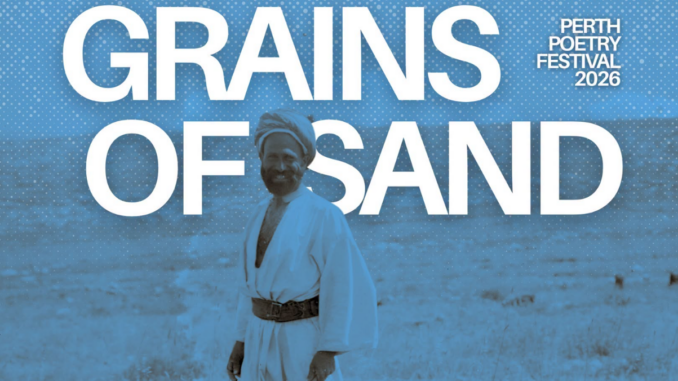
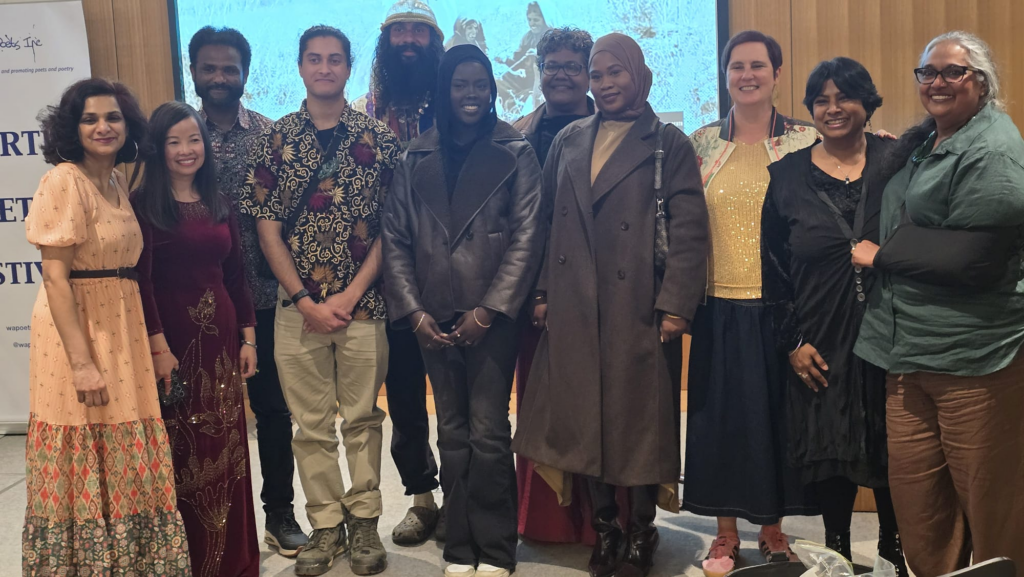
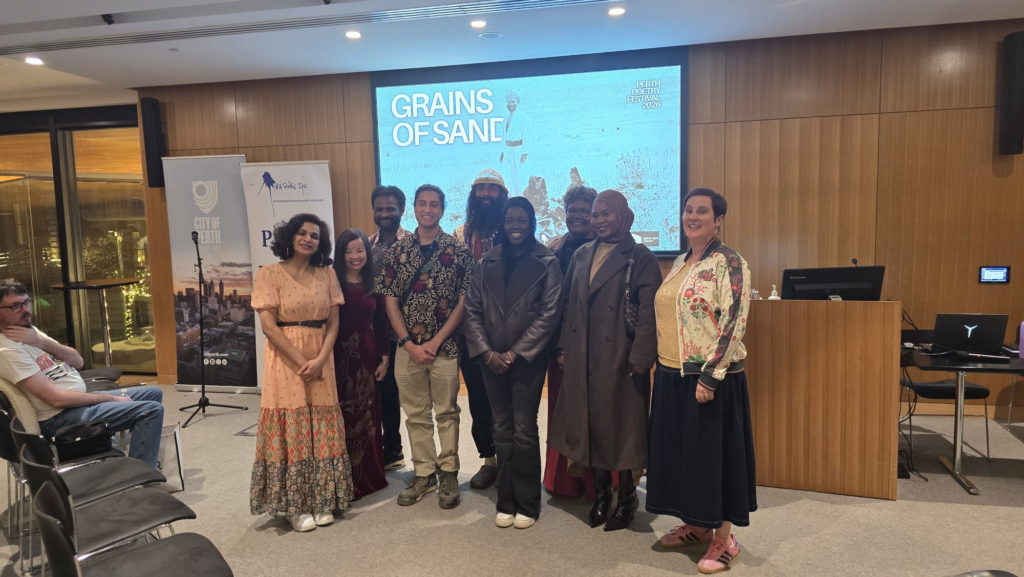
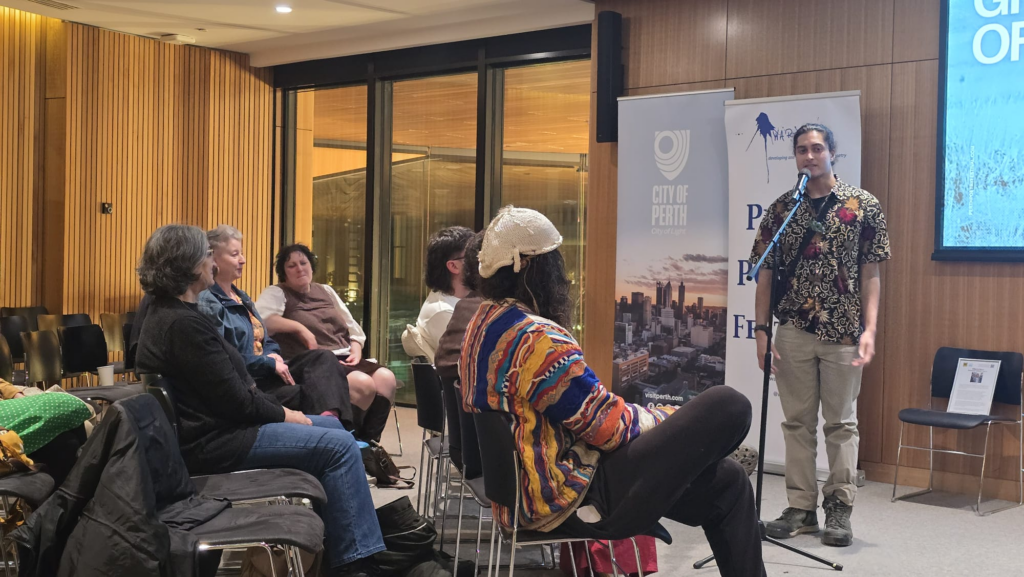
Grains of Sand, presented as part of the Perth Poetry Festival 2026: Ear to the Ground, brought many of these stories together for an evening of poetry, music, memory and reflection. The multicultural poetry showcase gave centre stage to writers and performers whose work crosses cultures, histories, places and lived experiences, tracing the many routes by which people make, remember and imagine home.From migration and displacement to Country, language, ancestry, motherhood and resilience, the evening demonstrated the extraordinary capacity of poetry to hold both personal memory and collective history.
The event opened with a welcome, an Acknowledgement of Country and an introduction to the evening’s themes. At its heart was a simple invitation: to allow the words of the poets to nestle within us, comfort us, move us and inspire us.
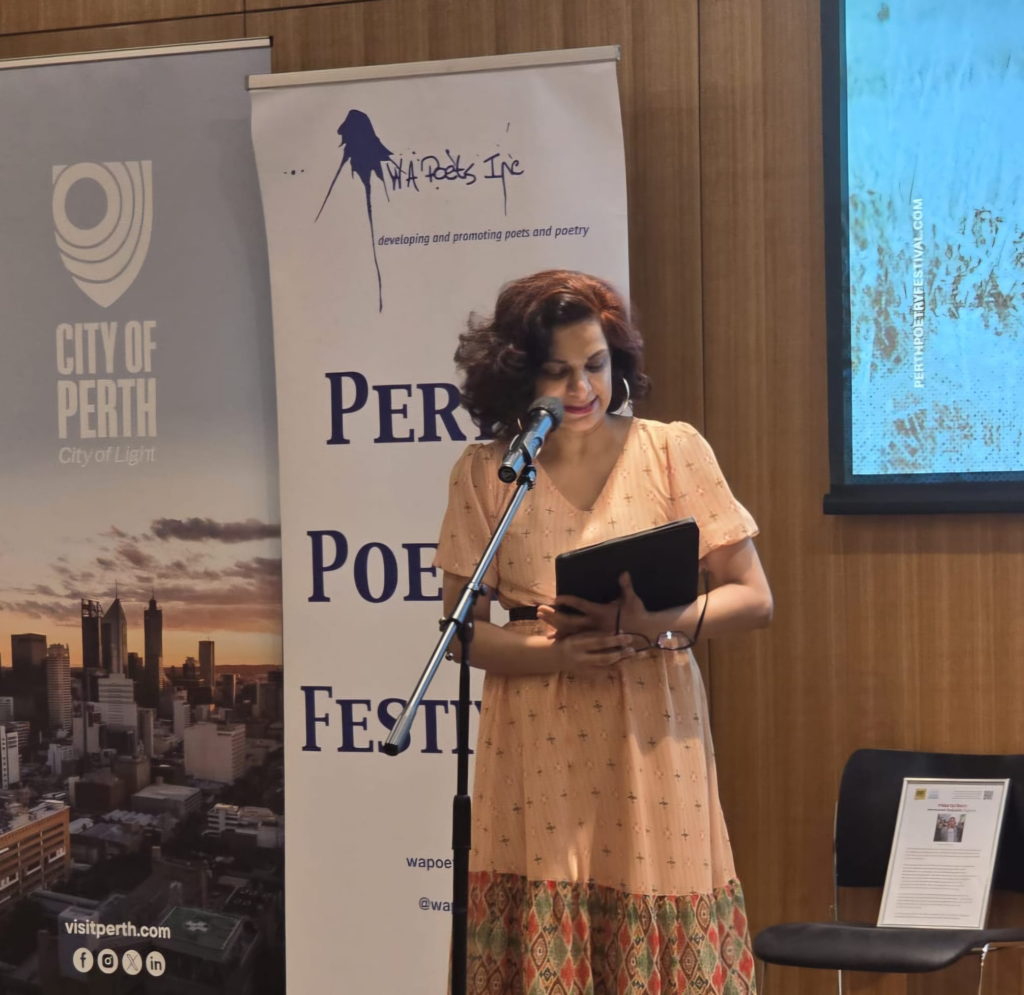
A particularly meaningful presence throughout the evening was an empty chair, deliberately reserved for writers, poets and activists from around the world whose words have the power to create change. The chair was dedicated to Mohamed Tadjadit, the Algerian poet and activist. Information about Tadjadit was placed on the chair, accompanied by a QR code, transforming the empty seat into a reminder that poetry does not exist only within the walls of a venue. It can also be an act of resistance, remembrance and solidarity.
.
Remembering What History Forgets
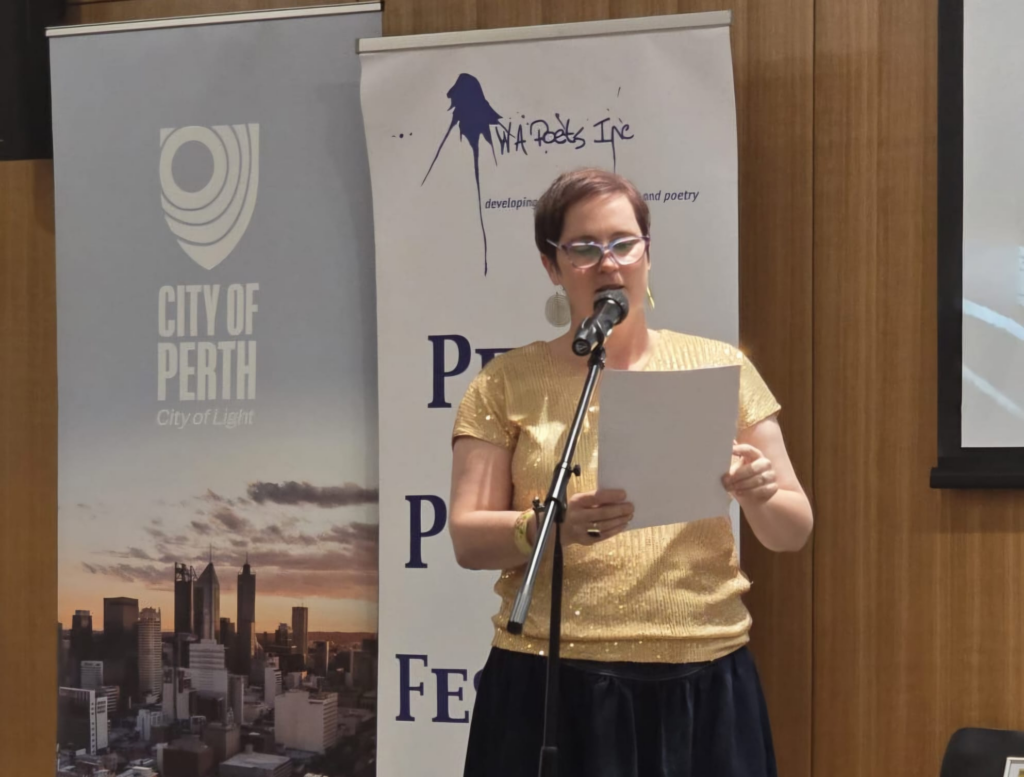
The evening began with Natalie Damjanovich-Napoleon whose work Commonwealth of Amnesia was recently released through the Rabbit Poets Series. Her performance combined poetry with a visual accompaniment of erasure poems, creating a layered meditation on family history and the silences of Australian history.
At the centre of the work was the story of her paternal grandfather, Uri Danich Napoleon, who arrived in Fremantle in 1926. He later worked on the woodlines around Kalgoorlie-Boulder, where immigrant labourers undertook some of the most physically demanding and poorly paid work associated with the gold industry.
His story was one of extraordinary sacrifice. After years of saving in the hope of bringing his wife and children to Western Australia, he made the desperate decision to deliberately injure himself in order to obtain insurance money to help finance their journey. But this was not presented simply as an individual family story. It unfolded against the wider realities of early twentieth-century Australia: the White Australia era, xenophobia, racism and the suspicion directed towards immigrants who did not fit narrow ideas of British or European identity.
The presentation also brought attention to the experiences of Croatian and other Austro-Hungarian civilians interned in Australia during the First World War, including those held on Rottnest Island under harsh, prison-like conditions. Some prisoners died during internment, while others were forcibly deported after the war.
The history of racial violence on the Western Australian goldfields also came into focus, including the Kalgoorlie riots, during which Croatian, Yugoslav and Italian families became targets of mobs. Homes, businesses and other buildings were destroyed, and families were forced to flee.
Through poetry, archival material, statistics, collage and woven names, the performance attempted to recover stories that had been pushed to the margins of Australia’s collective memory.
Ultimately, however, it returned to one man: a grandfather willing to sacrifice his own body for the possibility of bringing his family together. The work asked what happens when the suffering of earlier generations disappears from public memory and whether remembering can itself become an act of recognition.
.
Land, War and the Languages We Embrace
The evening continued with Oormila Vijayakrishnan Prahlad, whose poetry explored migration, belonging, memory and the complex experience of growing up between cultures. Drawing on her family history as a child refugee from the Middle East, Oormila examined the question of belonging through three works: The Land Never Asks, Preparing Her Children and At the Lookout.
In The Land Never Asks, the expectations humans place upon one another, to explain identity, origins and belonging, were contrasted with the generosity of land itself. The land does not demand a passport, an explanation or a justification for one’s presence.
Preparing Her Children moved into a deeply personal memory of wartime. At the age of twelve, Oormila and her brother were warned by their mother that they might not survive the night because of the threat of chemical weapons.
The poem captured the fear of childhood, but also the tenderness and courage of a mother trying to prepare her children for something no parent should ever have to contemplate.
Her final work turned towards language. Multiple languages became more than systems of communication; they became vessels for memory, emotion, rhythm and identity. Returning to a language can mean returning to the body, to family, to landscape and to people who may no longer be physically present.
Across the three works, migration emerged not as a simple journey from one country to another, but as an ongoing movement through memory, language, landscape and inherited identity.
.
Country, Connection and Ancient Knowledge
Jack Collard followed, bringing a different but deeply connected perspective on belonging. Described as a custodian of cultural and spiritual knowledge with responsibilities connected to Country, healing and ancestral traditions, Jack spoke about the importance of reconnecting with the natural world.
His presentation invited the audience to reconsider the boundaries between people and the world around them between human beings, trees, rocks, animals, water and land. Ancient knowledge, he explained, can be carried through song, dance, storytelling and ceremony. Yet such knowledge must be approached with humility rather than ego or a desire for power.
His words also challenged the divisions that people create around race, identity and bloodlines. Connection, he suggested, can instead be understood through respect, responsibility and a willingness to listen.
The performance became an invitation to look inward while simultaneously looking outward: to consider one’s relationship with Country, with other people and with the larger natural world. Healing, in this context, could begin with remembering what has been forgotten.
.
A Child Teaching a Language
Next came Vo Thi Nhu Mai, also known as Mai White, whose performance brought together poetry, language and the intimate relationship between parent and child. Mai performed her English poem Homeland, followed by the longer work The Child Who Teaches Me a Language, before returning to Homeland in Vietnamese.
The movement between English and Vietnamese created its own emotional landscape. Language became something inherited, something remembered and something continually remade. It could belong to the past while simultaneously being carried into the future.
In The Child Who Teaches Me a Language, the relationship between generations became particularly significant. A child can become not only the recipient of heritage, but also a teacher, someone through whom a parent encounters language, identity and belonging anew.
The performance demonstrated that language is never merely vocabulary. It carries family, place, memory, tenderness and the complicated histories of those who speak it. By presenting Homeland in both English and Vietnamese, Mai allowed the audience to hear how a poem can shift when it crosses linguistic borders while retaining its emotional centre.
Her performance offered a powerful reflection on what it means to inherit a homeland, to remember one and to create a sense of home across more than one language.
.
Love, Heritage and the Journey Home
Following Mai’s performance, Nidal Saeed and Huda Elhag presented a collaborative work rooted in family, displacement, heritage and memory. The performance drew on the history of Nidal’s grandparents, whose lives connected the south and north of Sudan, reflecting the geographical and political divisions that have shaped the country’s history.
Their work became an expression of love and remembrance. Images of mothers, fathers, brothers, trees and childhood memories were woven together with stories carried across generations. Heritage emerged as something that can survive displacement — something embedded in family narratives and carried within memory even when people are separated from the places they once called home.
The work also reflected on freedom and belonging, suggesting that loving someone sometimes means allowing them to follow their own journey. In this sense, home was not presented as a fixed location, but as something carried within people: through ancestry, family, memory and love.
.
I Have No Country
The question of borders and belonging returned in the work of award-winning Ethiopian poet and author Yirga Gelaw Woldeyes, from Lalibela. Yirga’s poetry has been published in The Cry of Mountains and performed widely across Ethiopian stages and radio.
His work drew upon Ethiopian understandings of nature and existence, exploring the interconnectedness of earth, water, fire, wind and humanity. Rather than placing human beings above or outside nature, his poetry suggested that we are formed from the same elements that make up the world around us.
His central poem, I Have No Country, challenged conventional ideas of nationality and borders. What does it mean to belong to a country when identity can extend beyond political boundaries?
Through images of soil, mountains, rivers, clouds, moonlight, wind and sky, Yirga presented the Earth itself as a shared home. His vision of belonging was expansive rather than restrictive. Identity could reach beyond passports, borders and inherited definitions of nationality. Freedom, in his work, became the possibility of existing beyond the limitations imposed by borders.
.
Water Remembers
The evening then moved into the powerful work of Cindy Moody, a Yuit, Mamong and Whadjuk woman, businesswoman, visual artist, singer-songwriter and musician. Cindy’s creative practice is deeply connected to community, culture and Country, and she has participated in collaborative arts projects, community workshops and large-scale communal artworks incorporating Aboriginal symbols and seasonal themes.
Her contribution began with spoken word centred on water. Water became a symbol of Country, identity and memory, a living force that carries stories through time. The Earth remembers footsteps. Water carries voices.
The movement of waves became a metaphor for Cindy’s own life: constantly changing, yet continually connected to where she comes from. She then performed an award-winning song written for her son, Jeremy.
The song brought a deeply personal dimension to the performance, reflecting the enduring connection between mother and son despite periods of separation. It became an expression of maternal love, cultural identity and hope.
Together, the spoken word and song demonstrated how Country, water, language and family can preserve memory across generations. Distance may separate people, but it cannot necessarily erase connection.
.
From Poetry to Hip-Hop
The evening concluded with Suraj, a multidisciplinary artist whose practice spans singer-songwriter, rapper, producer, DJ and hip-hop performance, including recent performances in Kenya and Johannesburg. Suraj brought a striking shift in rhythm and energy to the programme.
The first piece centred on personal empowerment, spiritual strength and the transformative possibilities of creative expression. The performance challenged audiences to look beyond conventional institutions and external sources of authority, encouraging people to recognise their own inner strength and use their voices to confront darkness, trauma and injustice.
Images of light, broken futures, resilience and becoming a beacon for others gave the work an urgent and motivational quality. Suraj then performed Mullā, explaining that the title refers not to money, but to the first 13 degrees of Sagittarius and its association with Ketu.
The piece questioned the relationship between material wealth and genuine power. Possessions, status and outward success were placed against qualities such as truth, presence, passion and inner strength.
Through sharp wordplay and rhythmic delivery, Suraj challenged the audience to consider what remains when material things are stripped away.The answer was not wealth. It was authenticity. It was presence. It was the determination to survive, create and overcome.
.
Many Voices, One Shared Ground
As the evening came to a close, the individual performances began to reveal their deeper connections. The poets had arrived from different histories and cultural contexts, carrying distinct languages, landscapes and memories, while their artistic forms ranged from archival and erasure poetry to spoken word, song and hip-hop. Yet again and again, the same questions emerged: Where is home? Who gets to belong? What do we inherit? What do we remember? What happens when a language, a family story or a cultural memory is lost? And, perhaps most importantly, how do we carry those things forward? The title Grains of Sand offered an apt metaphor for the evening: a single grain may appear insignificant, but countless grains together form beaches, dunes and landscapes; so too with stories, a family memory, a poem, a language, a song, a name, a landscape, a story passed from grandmother to child, a history recovered from an archive, a voice refusing to be forgotten. Each is a grain, and together they create something much larger than themselves. Grains of Sand celebrated poetry not simply as an art form, but as a way of remembering, questioning, connecting and imagining, reminding us that home can be a country, a language, a family, a river, a song, a childhood memory, or something we are still learning to name. And as the final words faded, the invitation remained: listen closely, remember, and carry the stories with you.
.
ABOUT THE MC: ASHA RAJAN
Asha Rajan is a South Indian (Malayalee)-Australian writer, editor and literary creative who lives and works on Whadjuk Noongar boodjar, land which was never ceded. She acknowledges with respect the Elders and Custodians of this Country — the first storytellers, songwriters and poets of this land.
Asha’s work spans writing, editing, publishing and literary community engagement. She was a Contributing Editor at the online writing community YeahWrite, where she also judged a number of Super Challenge competitions. From January 2015 to May 2020, she was an editor at the online literary micro-essay publication Dead Housekeeping, becoming its Managing Editor in May 2020. She continues to work as a freelance editor, with an interest in a wide range of literary and creative projects.
Her writing has appeared in a diverse range of journals, magazines, anthologies and chapbooks, including The Writers’ Collective, The Pocketry Almanack, Cordite Poetry Review, The Ekphrastic Review, Portside Review, Rabbit, Peril Magazine, Ellipsis Zine, Modern Loss, [PANK], The Drabble, Mountain Bluebird Magazine, Ourselves: 100 Micro Memoirs, and A Sense of Place, among others. Her work has also been included in international and Australian anthologies, including Instantáneas de Ficción Vol. 3, Brushstrokes II, Grieve Volume 9 and The Cyberettes.
Asha’s literary achievements include second place in the Stuart Hadow Short Story Prize (2023), a longlisting for The Masters Review Reprint Prize (2023), acceptance for publication in Brushstrokes IV through the Ros Spencer Poetry Prize (2023), and a Highly Commended in the Marj Wilke Short Story Award (2022). In 2020, she won the Bronze Quill Award from the Society of Women Writers WA and was also Highly Commended in the Heroines Women’s Writing Prize.
Her work extends beyond the page into live literary and community spaces. She has participated in readings, workshops, festivals, panels and creative events across Perth and beyond, including Perth Poetry Festival, Perth Storyfest, Hakaya of Home Fremantle, Woman Scream, Iinji Film Festival, The Blue Room Theatre, The University of Western Australia, Centre for Stories, WA Poets Inc., and events presented by the Society of Women Writers WA.
With her practice grounded in writing, editing, cultural reflection and community, Asha brings both literary experience and a strong commitment to creating spaces where stories can be heard. As MC of Grains of Sand, she was not simply the voice introducing each performer; she helped hold together an evening devoted to the many ways poetry can cross borders, preserve memory and create connections between people, cultures and places.
Thank you for reading. See you in the next article.